
Elastic Backup and Restore
Elastic Backup
- Navigate to the scripts directory.
-
Run the script using the application provided python binary, example
/home/appviewx/appviewx/appviewx_dependency/appviewx_addons/Python_Linux/bin/python -
Before taking the backup we have to set up the Elasticsearch repo for
storing the snapshots.
/home/appviewx/appviewx/appviewx_dependency/appviewx_addons/Python_Linux/bin/python elastic_backup.py --setup elasticsearch_insight -
To take the backup run the command
/home/appviewx/appviewx/appviewx_dependency/appviewx_addons/Python_Linux/bin/python elastic_backup.py --backup elasticsearch_insight -
Perform the following steps after taking the backup
- Navigate to the clusters node where the elasticsearch-insight is deployed
- Navigate to the installer path and create the tar of the elastic-insight-backup directory
- Copy the backup tar into the installer node.
Elastic Restore
- Navigate to the scripts directory.
-
Run the elastic_restore.py script to restore the backup
/home/appviewx/appviewx/appviewx_dependency/appviewx_addons/Python_Linux/bin/python elastic_restore.py elasticsearch_insight -
Script will ask for the backup tar which was created manually. Provide the
absolute path of the backup tar.
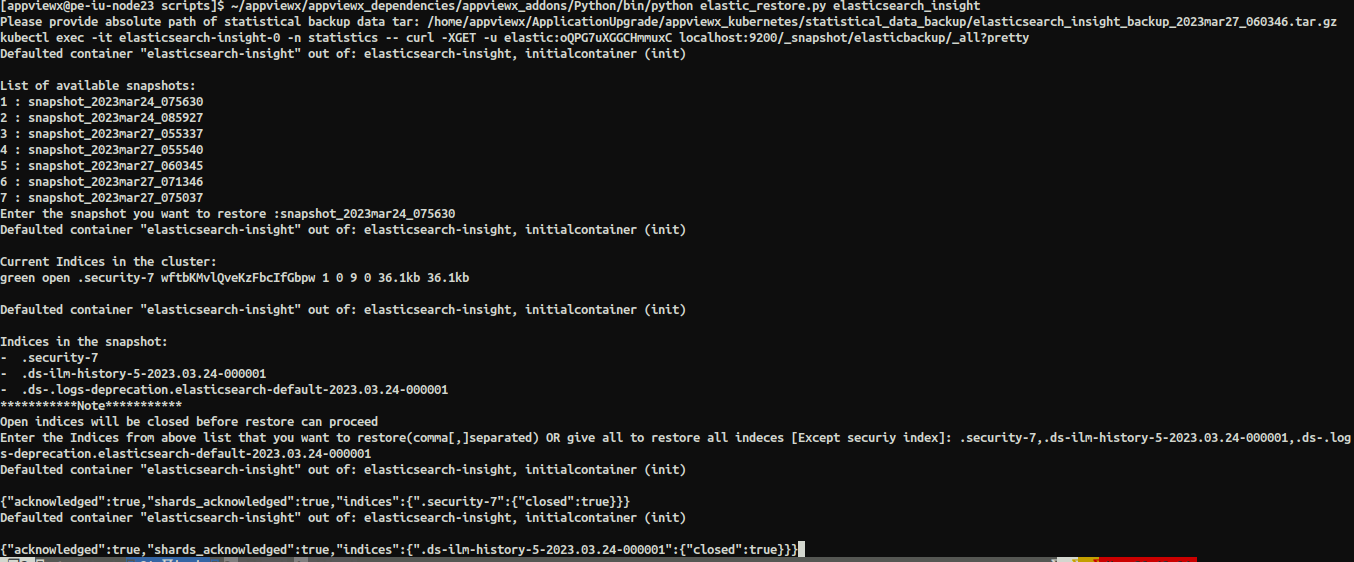
- Script will list all the available snapshots that has date and time in the naming. Select the backup which you want to restore.
- Provide the details of the indices you want to restore (follow the screenshot above).
