
Create F5 LTM VIP with DNS
This workflow creates App Owner Centric VIP and integrates with DNS - Infoblox/Bluecat for A record creation.
To run this workflow:- Go to Menu > ADC+ > AUTOMATION > Workflow Catalog > View/Run
- Click the F5 BIG-IP LTM category on the View/Run Workflows page.
- On the popup window, hover over the Create F5 LTM VIP with DNS workflow.
-
Click the Run
 button.
The Request > Create F5 LTM VIP with DNS :: FormBuilder page is displayed.
button.
The Request > Create F5 LTM VIP with DNS :: FormBuilder page is displayed. -
Enter/select the Device Details.
Table 1. Device Details Section - Field and Description Table Field Description *Datacenter Displays the list of datacenters of the devices, which are created in the Device Inventory. Select the datacenter of a device from the drop-down option for which this request is to be added. For the devices which are created without a datacenter in the Device Inventory, select the datacenter as None. *Device Name Displays the list of devices associated with the selected datacenter. If the datacenter is selected as None, the devices that are created without datacenter details are listed. Select the desired device from the drop-down option. -
Enter/select the DNS Record Details.
Table 2. DNS Record Details Section - Field and Description Table Field Description Do you want to create A record? The default option is No. To create A record in DNS select Yes and enter the Vendor, DNS Device, Network View, and Subnet details.
-
Enter/select the Virtual Details.
Table 3. Virtual Details Section - Field and Description Table Field Description FQDN/Application Name Enter the FQDN or application name of the virtual server. Do you need to Enable SSL Certificates? Select any of the following options to enable SSL certificates. The default option is No-InSecure Site.
- No-InSecure Site
-
Yes - Only the servers will have SSL certificates
- No – The only Client will have an SSL Certificate
- Yes - Both Client and Servers will have SSL certificates
IP Choice This option is applicable when a DNS record is to be created. Select any of the following IP choices:
- Manual - allows to give the IP manually.
- Next Available IP from IPAM - allows to fetch the next available IP from IPAM. To get the IP, click the Fetch Next Available IP and Reserve button.
Destination Address Enter the destination IP address information for the virtual server. Service Port Enter a service port. -
Enter/select the Pool and Monitor Details.
Table 4. Field descriptions for the Pool and Monitor Details section Field Description Load Balancing Method The load balancing method is used to select a pool in this WideIP. The default is round-robin. The methods are:
- round-robin - the system selects the pools sequentially.
- least-connection-node - The system passes a new connection to the node that has the least number of current connections out of all pools of which a node is a member. This method works best in environments where the servers or other equipment you are load balancing have similar capabilities. This is a dynamic load balancing method, distributing connections based on various aspects of real-time server performance analysis, such as the number of current connections per node, or the fastest node response time.
- least-connection-member - The system passes a new connection to the node that has the least number of current connections in the pool. This method works best in environments where the servers or other equipment you are load balancing have similar capabilities. This is a dynamic load balancing method, distributing connections based on various aspects of real-time server performance analysis, such as the current number of connections per node or the fastest node response time.
- ratio-member - The number of connections that each machine receives over time is proportionate to a ratio weight you define for each machine within the pool.
Address Enter the IP address of the pool. Service Port Enter a service port. State The current state of the pool members. The states are:
- user-enabled - when you select this option, the system sends traffic to this pool member regardless of the pool member's state.
- user-disabled - when this option is selected, the pool member can handle only persistent or active connections.
Pool Members Enter the IP address of the pool member. And then click the Add button. Any number
of pool numbers can be added to the pool. After adding the pool, you can
manage them.
button. Any number
of pool numbers can be added to the pool. After adding the pool, you can
manage them.
Monitor / Health Check Type Select the health monitors that are available to add for the pool:
- HTTP
- TCP
Request Method and URI The text string that the monitor sends to the target object. You must include \r\n at the end of a non-empty Send String. The default setting is GET /\r\n, which retrieves a default HTML file for a website. To retrieve a specific page from a website, specify a fully qualified path name. Expected Response The regular expression representing the text string that the monitor looks for in the returned resource. The most common receive expressions contain a text string that is included in an HTML file on your site. The text string can be regular text, HTML tags, or image names, and the associated operation is not case-sensitive. -
Enter/select the Snat Pool Details.
Table 5. Snat Pool Details Section - Field and Description Table Field Description Snat Choice Select the SNAT choice for any connections using this pool. The options are:
- AutoMap -This option allows you to select a translation address from the available self-IP address.
- SNAT - This option allows you to select a floating self IP as a translation address. When this option is selected, the Snat Pool field appears. Select the Snat pool from the drop-down option:
-
Enter/select the Persistence Details.
Table 6. Persistence Details Section - Field Description Table Field Description Persistence This option allows you to use a pre-configured object that automatically enables persistence when you assign the profile to a virtual server.
- None
- Create New - create a new persistence by providing persistence details:
- Existing - select the existing persistence details:
Note: If you need to cancel the request, make sure that you unreserve the IP.To unreserve the IP, click Un-reserve IP.
-
Click Submit.
The Confirmation popup opens.
-
To save this form so you can edit it later, click Save Draft and then click
OK.
The form will be saved as Open request under Request > My Request.
OR
To submit the form, click OK.
The pre-validation starts automatically and reaches the Review stage. -
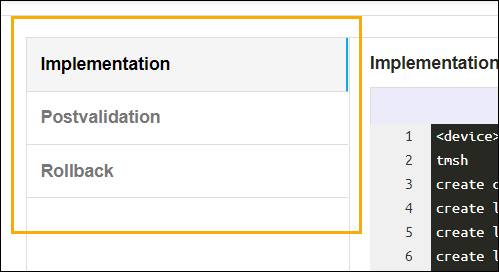
Review the input data under the implementation, rollback, and
postvalidation tabs.
-
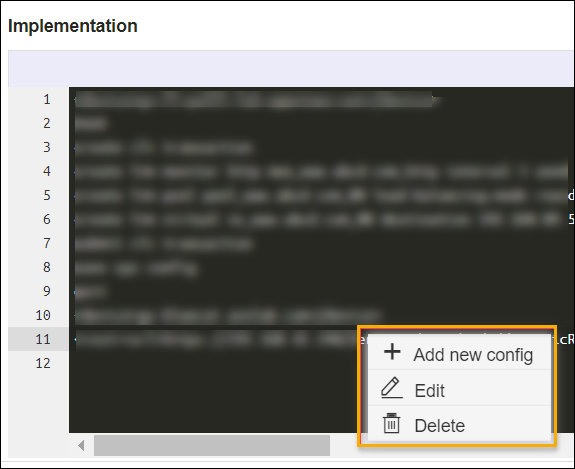
(Optional) If you need to change any data at this stage, you can update by clicking the
right mouse button.
-
After the review, click Submit.
The Confirmation dialog box is displayed.
-
To continue with the workflow creation, click Ok
OR
To abort the workflow creation, click Cancel.
It takes a while to complete the post-validation.After the post-validation is successful, the workflow is created and an email triggered to all the configured email IDs.
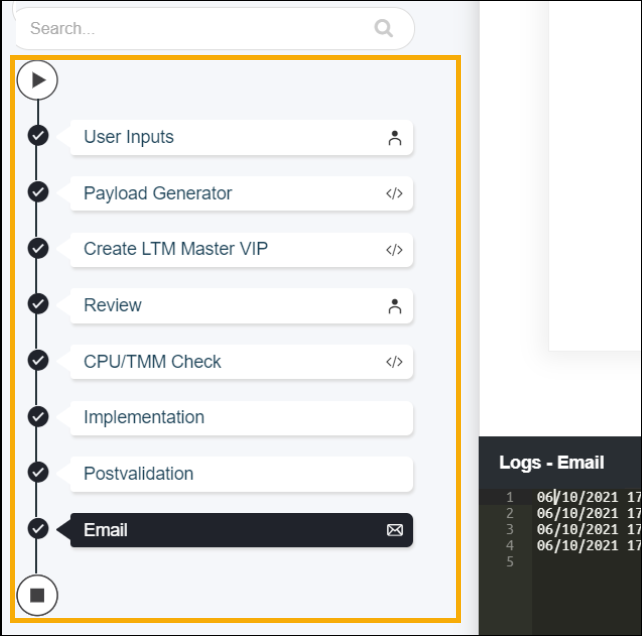 Note: The validation stages are shown in the left side of the screen. To view a validation stage, click on the respective stage.
