
Unmanaged Agent Details
Open to view AI agent activity identified through supported unmanaged-agent discovery mechanisms.
The page provides an enterprise-level view of detected unmanaged agents and their distribution across AI platforms.
Agents Overview
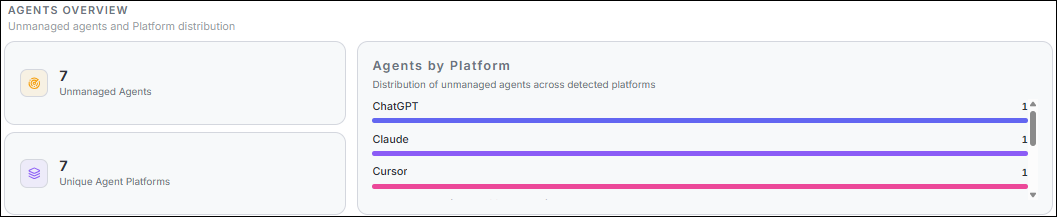
The Agents Overview summarizes the unmanaged agent population observed across the environment.
| Information | What it tells you |
|---|---|
| Unmanaged Agents | Number of agents currently identified as unmanaged. |
| Unique Agent Platforms | Number of distinct AI platforms represented by the detected agents. |
| Agents by Platform | Distribution of unmanaged agents across detected platforms. |
Agent Registry
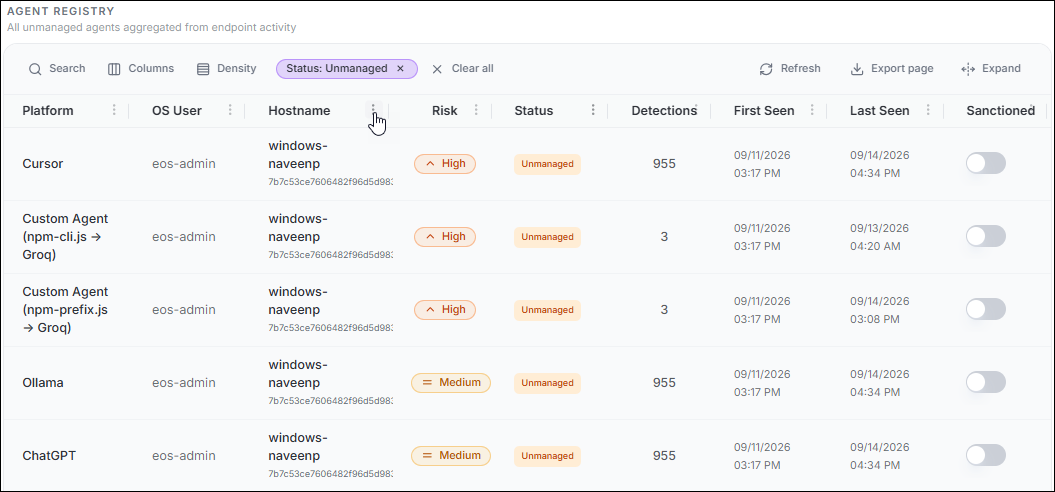
The Agent Registry lists the individual unmanaged agents identified from endpoint activity and provides the context available for each detection.
Depending on the available detection information, the registry can show details such as:
| Field | Description |
|---|---|
| Platform | AI platform associated with the detected activity. |
| OS User | Endpoint user associated with the detection. |
| Hostname | Endpoint on which the activity was detected. |
| Risk | Current risk level associated with the unmanaged agent. |
| Status | Indicates that the agent is currently unmanaged. |
| Detections | Number of detections associated with the agent. |
| First Seen | When the agent was first detected. |
| Last Seen | Most recent detection. |
| Sanctioned | Indicates whether the organization has sanctioned the detected agent. |
Detection Logs
Select Detection Logs to investigate the activity that contributed to unmanaged-agent discovery.
Detection information provides additional context for understanding why the activity was identified and helps security teams distinguish expected enterprise AI usage from activity that requires further investigation.
The information available can vary depending on the discovery mechanism and the context captured for the detection.
Investigating an Unmanaged Agent
When an unmanaged agent is detected, use the available information to understand the activity before deciding how it should be handled.
This approach allows organizations to use unmanaged-agent discovery as a visibility and investigation capability rather than assuming that every detected Shadow AI agent represents a security violation.
