
For Code Scan Outcome Analysis
Scope of Discovery
- Scanning covers:
- Source code repositories (Java, Python, C/C++)
- Build artifacts (JARs, DLLs, binaries)
- Embedded certificates inside applications
- Third-party crypto libraries (OpenSSL, BouncyCastle, WolfSSL, etc.)
- Custom libraries uploaded for scanning.
- Ensures PQC readiness evaluation includes both application code and dependencies.
- Ensure all critical repos and binaries are included in the scan scope.
Algorithm Detection
- Symmetric
- Asymmetric
- Hash
- Key Derivation Functions (KDFs)
- Message Authentication Codes.
- RSA/ECC/DH are quantum-vulnerable.
- MD5/SHA-1 are already insecure.
- PQC adoption requires NIST-recommended replacements.
- Replace vulnerable algorithms with PQC or hybrid alternatives.
- Ensure KDFs and symmetric algorithms meet NIST security levels.
Quantum Readiness Overview
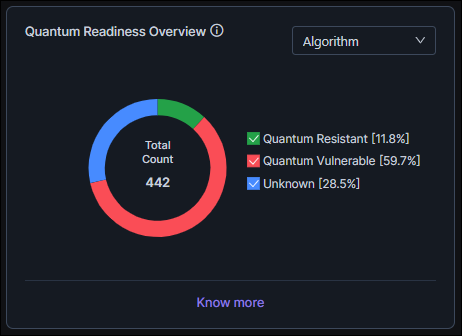
Quantum vulnerable: Code that is embedded with classical public-key algorithms that are at risk in a post-quantum environment
Quantum resistant: Code that is embedded with post-quantum or hybrid implementations designed to withstand classical as well as quantum computational attacks
Additionally, a code scan may return unknown findings for crypto assets that can be scanned only in runtime.
- Direct cryptographic usage: Cryptographic algorithms and operations that are implemented or invoked directly in the application code
- Library-based cryptographic usage: Cryptographic functionality provided indirectly through third-party libraries, SDKs, or frameworks that internally use cryptographic algorithms
As seen in the image, the chart is rendered using three segments, Quantum Resistant, Quantum Vulnerable, and Unknown (Runtime-Resolved) each representing the percentage distribution of the quantum exposure findings.
- Use the filter in the top-right corner of the chart to view the quantum readiness according to the following usage patterns: direct cryptographic usage (Algorithm) and library-based cryptographic usage (Library)
- Hover over each segment to see the percentage distribution (also displayed in the chart legend).
- Click a legend to show/hide the corresponding category on the chart.
- Click Know More for a detailed reading and the recommended next steps.
Severity Assessment (NIST-Aligned)
 Critical
  High
High  Medium
 Low
Low
- If the cryptographic algorithm is referenced from a constant, variable, configuration, or resolved at runtime and cannot be determined through static analysis, the algorithm cannot be determined and will be marked as Unknown
- If there are no key lengths mentioned in the cryptographic class ,then the severity would be marked as High.
| Algorithm | NIST Status | Severity based on Grovers/Shor Analysis | PQC Readiness |
|---|---|---|---|
| AES-128 | Approved (FIPS 197) | High | Quantum Vulnerable |
| AES-192 | Approved (FIPS 197) | High | Quantum Vulnerable |
| AES-256 | Approved (FIPS 197) | Low (Quantum Safe) | Quantum Resistant |
| AES-128-ECB | Approved (FIPS 197) | High | Quantum Vulnerable |
| AES-192-ECB | Approved (FIPS 197) | High | Quantum Vulnerable |
| AES-256-ECB | Approved (FIPS 197) | High | Quantum Vulnerable |
| AES-128-CBC | Approved (FIPS 197 / SP 800-38A) | High | Quantum Vulnerable |
| AES-192-CBC | Approved (FIPS 197 / SP 800-38A) | High | Quantum Vulnerable |
| AES-256-CBC | Approved (FIPS 197 / SP 800-38A) | Low (Quantum Safe) | Quantum Resistant |
| AES-128-CTR | Approved (FIPS 197 / SP 800-38A) | High | Quantum Vulnerable |
| AES-192-CTR | Approved (FIPS 197 / SP 800-38A) | High | Quantum Vulnerable |
| AES-256-CTR | Approved (FIPS 197 / SP 800-38A) | Low (Quantum Safe) | Quantum Resistant |
| AES-128-GCM | Approved (FIPS 197 / SP 800-38D) | High | Quantum Vulnerable |
| AES-192-GCM | Approved (FIPS 197 / SP 800-38D) | High | Quantum Vulnerable |
| AES-256-GCM | Approved (FIPS 197 / SP 800-38D) | Low (Quantum Safe) | Quantum Resistant |
| Camellia-128-CBC | Approved (ISO/IEC 18033-3 / JIS X 6319-3) | High | Quantum Vulnerable |
| Camellia-192-GCM | Approved (ISO/IEC 18033-3 / JIS X 6319-3) | High | Quantum Vulnerable |
| Camellia-256-GCM | Approved (ISO/IEC 18033-3 / JIS X 6319-3) | Low (Quantum Safe) | Quantum Resistant |
| CAMELLIA-128 | Approved / Recognized (SP 800-57) | High | Quantum Vulnerable |
| CAMELLIA-192 | Approved / Recognized (SP 800-57) | High | Quantum Vulnerable |
| CAMELLIA-256 | Approved / Recognized (SP 800-57) | Low (Quantum Safe) | Quantum Resistant |
| Camellia-192-CBC | Approved (ISO/IEC 18033-3 / JIS X 6319-3) | High | Quantum Vulnerable |
| Camellia-256-CBC | Approved (ISO/IEC 18033-3 / JIS X 6319-3) | Low (Quantum Safe) | Quantum Resistant |
| Camellia-128-GCM | Approved (ISO/IEC 18033-3 / JIS X 6319-3) | High | Quantum Vulnerable |
| CAMELLIA-128-CTR | Approved / Recognized (SP 800-57) | High | Quantum Vulnerable |
| CAMELLIA-192-CTR | Approved / Recognized (SP 800-57) | High | Quantum Vulnerable |
| CAMELLIA-256-CTR | Approved / Recognized (SP 800-57) | Low (Quantum Safe) | Quantum Resistant |
| CAMELLIA-128-CCM | Approved / Recognized (SP 800-38C, ISO/IEC 18033-3) | High | Quantum Vulnerable |
| CAMELLIA-192-CCM | Approved / Recognized (SP 800-38C, ISO/IEC 18033-3) | High | Quantum Vulnerable |
| CAMELLIA-256-CCM | Approved / Recognized (SP 800-38C, ISO/IEC 18033-3) | Low (Quantum Safe) | Quantum Resistant |
| AES-128-CCM | Approved (FIPS 197 / SP 800-38C) | High | Quantum Vulnerable |
| AES-192-CCM | Approved (FIPS 197 / SP 800-38C) | High | Quantum Vulnerable |
| AES-256-CCM | Approved (FIPS 197 / SP 800-38C) | Low (Quantum Safe) | Quantum Resistant |
| AES-128-OCB | Approved (FIPS 197 / RFC 7253) | High | Quantum Vulnerable |
| AES-192-OCB | Approved (FIPS 197 / RFC 7253) | High | Quantum Vulnerable |
| AES-256-OCB | Approved (FIPS 197 / RFC 7253) | Low (Quantum Safe) | Quantum Resistant |
| AES-128-XTS | Approved (SP 800-38E) | High | Quantum Vulnerable |
| AES-256-XTS | Approved (SP 800-38E) | Low (Quantum Safe) | Quantum Resistant |
| AES-128-CFB | Approved (SP 800-38A) | High | Quantum Vulnerable |
| AES-192-CFB | Approved (SP 800-38A) | High | Quantum Vulnerable |
| AES-256-CFB | Approved (SP 800-38A) | Low (Quantum Safe) | Quantum Resistant |
| AES-128-CFB1 | Approved (SP 800-38A) | High | Quantum Vulnerable |
| AES-192-CFB1 | Approved (SP 800-38A) | High | Quantum Vulnerable |
| AES-256-CFB1 | Approved (SP 800-38A) | Low (Quantum Safe) | Quantum Resistant |
| AES-128-CFB8 | Approved (SP 800-38A) | High | Quantum Vulnerable |
| AES-192-CFB8 | Approved (SP 800-38A) | High | Quantum Vulnerable |
| AES-256-CFB8 | Approved (SP 800-38A) | Low (Quantum Safe) | Quantum Resistant |
| AES-128-OFB | Approved (SP 800-38A) | High | Quantum Vulnerable |
| AES-192-OFB | Approved (SP 800-38A) | High | Quantum Vulnerable |
| AES-256-OFB | Approved (SP 800-38A) | Low (Quantum Safe) | Quantum Resistant |
| AES-128-SIV | Approved (SP 800-38F) | High | Quantum Vulnerable |
| AES-192-SIV | Approved (SP 800-38F) | High | Quantum Vulnerable |
| AES-256-SIV | Approved (SP 800-38F) | Low (Quantum Safe) | Quantum Resistant |
| AES-128-WRAP | Approved (SP 800-38F) | High | Quantum Vulnerable |
| AES-192-WRAP | Approved (SP 800-38F) | High | Quantum Vulnerable |
| AES-256-WRAP | Approved (SP 800-38F) | Low (Quantum Safe) | Quantum Resistant |
| AES-128-KW | Approved (SP 800-38F) | High | Quantum Vulnerable |
| AES-192-KW | Approved (SP 800-38F) | High | Quantum Vulnerable |
| AES-256-KW | Approved (SP 800-38F) | Low (Quantum Safe) | Quantum Resistant |
| 3DES-112 | Approved (FIPS 46-3 / SP 800-67) | High | Quantum Vulnerable |
| 3DES-168 | Approved (FIPS 46-3 / SP 800-67) | High | Quantum Vulnerable |
| Blowfish-128 | Not Approved / Legacy | Critical | Quantum Vulnerable |
| Blowfish-192 | Not Approved / Legacy | Critical | Quantum Vulnerable |
| Blowfish-256 | Not Approved / Legacy | Critical | Quantum Vulnerable |
| Twofish-128 | Not Approved / Legacy | High | Quantum Vulnerable |
| Twofish-192 | Not Approved / Legacy | High | Quantum Vulnerable |
| Twofish-256 | Not Approved / Legacy | High | Quantum Vulnerable |
| Threefish-256 | Not Approved / Legacy | High | Quantum Vulnerable |
| Threefish-512 | Not Approved / Legacy | Low (Quantum Safe) | Quantum Resistant |
| THREEFISH-1024 | Not Approved / Legacy | Low (Quantum Safe) | Quantum Resistant |
| Serpent -128 | Not Approved / Legacy | High | Quantum Vulnerable |
| Serpent -192 | Not Approved / Legacy | High | Quantum Vulnerable |
| Serpent -256 | Not Approved / Legacy | Low (Quantum Safe) | Quantum Resistant |
| ChaCha20 | Not FIPS-approved | Low (Quantum Safe) | Quantum Resistant |
| XChaCha20 | Not FIPS-approved | Low (Quantum Safe) | Quantum Resistant |
| ChaCha20-Poly1305 | Not FIPS-approved | Low (Quantum Safe) | Quantum Resistant |
| XChaCha20-Poly1305 | Not FIPS-approved | Low (Quantum Safe) | Quantum Resistant |
| AES-128-POLY1305 | Approved / FIPS 197, SP 800-38D | High | Quantum Vulnerable |
| AES-192-POLY1305 | Approved / FIPS 197, SP 800-38D | High | Quantum Vulnerable |
| AES-256-POLY1305 | Approved / FIPS 197, SP 800-38D | Low (Quantum Safe) | Quantum Resistant |
| DES-56 | Deprecated (FIPS 46-3) | Critical | Quantum Vulnerable |
| RC2-40 | Deprecated (SP 800-38 / Legacy) | Critical | Quantum Vulnerable |
| RC2-64 | Deprecated (SP 800-38 / Legacy) | Critical | Quantum Vulnerable |
| RC2-128 | Deprecated (SP 800-38 / Legacy) | Critical | Quantum Vulnerable |
| RC4-40 | Deprecated / Weak | Critical | Quantum Vulnerable |
| RC4-128 | Deprecated / Weak | Critical | Quantum Vulnerable |
| RC2-256 | Deprecated / Weak | Critical | Quantum Vulnerable |
| RC4-40 | Deprecated / Weak | Critical | Quantum Vulnerable |
| RC4-64 | Deprecated / Weak | Critical | Quantum Vulnerable |
| RC4-128 | Deprecated / Weak | Critical | Quantum Vulnerable |
| RC4-256 | Deprecated / Weak | Critical | Quantum Vulnerable |
| RC5-32-128 | Deprecated / Weak | Critical | Quantum Vulnerable |
| RC5-32-192 | Deprecated / Weak | Critical | Quantum Vulnerable |
| RC5-32-256 | Deprecated / Weak | Critical | Quantum Vulnerable |
| RC5-64-128 | Deprecated / Weak | Critical | Quantum Vulnerable |
| RC5-64-192 | Deprecated / Weak | Critical | Quantum Vulnerable |
| RC5-64-256 | Deprecated / Weak | Critical | Quantum Vulnerable |
| RC5-128-128 | Deprecated / Weak | Critical | Quantum Vulnerable |
| RC5-128-192 | Deprecated / Weak | Critical | Quantum Vulnerable |
| RC5-128-256 | Deprecated / Weak | Critical | Quantum Vulnerable |
| RC6-128 | Not FIPS-approved | High | Quantum Vulnerable |
| RC6-192 | Not FIPS-approved | High | Quantum Vulnerable |
| RC6-256 | Not FIPS-approved | High | Quantum Vulnerable |
| RC6-512 | Not FIPS-approved | Low (Quantum Safe) | Quantum Resistant |
| RC6-1024 | Not FIPS-approved | Low (Quantum Safe) | Quantum Resistant |
| Rijndael-128 | Not FIPS-approved | High | Quantum Vulnerable |
| Rijndael-192 | Not FIPS-approved | High | Quantum Vulnerable |
| Rijndael-256 | Not FIPS-approved | Low (Quantum Safe) | Quantum Resistant |
| IDEA-128 | Not NIST-approved / Obsolete | Critical | Quantum Vulnerable |
| ARIA-128 | Not FIPS-approved | High | Quantum Vulnerable |
| ARIA-192 | Not FIPS-approved | High | Quantum Vulnerable |
| ARIA-256 | Not FIPS-approved | Low (Quantum Safe) | Quantum Resistant |
| ARIA-128-CBC | Not FIPS-approved | High | Quantum Vulnerable |
| ARIA-192-CBC | Not FIPS-approved | High | Quantum Vulnerable |
| ARIA-256-CBC | Not FIPS-approved | Low (Quantum Safe) | Quantum Resistant |
| ARIA-128-CTR | Not FIPS-approved | High | Quantum Vulnerable |
| ARIA-192-CTR | Not FIPS-approved | High | Quantum Vulnerable |
| ARIA-256-CTR | Not FIPS-approved | Low (Quantum Safe) | Quantum Resistant |
| ARIA-128-GCM | Not FIPS-approved | High | Quantum Vulnerable |
| ARIA-192-GCM | Not FIPS-approved | High | Quantum Vulnerable |
| ARIA-256-GCM | Not FIPS-approved | Low (Quantum Safe) | Quantum Resistant |
| ARIA-128-CCM | Not FIPS-approved | High | Quantum Vulnerable |
| ARIA-192-CCM | Not FIPS-approved | High | Quantum Vulnerable |
| ARIA-256-CCM | Not FIPS-approved | Low (Quantum Safe) | Quantum Resistant |
| RC6-128 | Not FIPS-approved | Critical | Quantum Vulnerable |
| RC6-192 | Not FIPS-approved | High | Quantum Vulnerable |
| RC6-256 | Not FIPS-approved | Low (Quantum Safe) | Quantum Resistant |
| Algorithm | NIST Status | Severity based on Grovers/Shor Analysis | PQC readiness |
|---|---|---|---|
| RSA-512 | Approved (Deprecated, FIPS 186-4 / SP 800-131A) | Critical | Quantum Vulnerable |
| RSA-768 | Approved (Deprecated, FIPS 186-4 / SP 800-131A) | Critical | Quantum Vulnerable |
| RSA-1024 | Approved (Deprecated, FIPS 186-4 / SP 800-131A) | Critical | Quantum Vulnerable |
| RSA-1536 | Approved (Deprecated, FIPS 186-4 / SP 800-131A) | Critical | Quantum Vulnerable |
| RSA-2048 | Approved (FIPS 186-4 / SP 800-131A) | High | Quantum Vulnerable |
| RSA-3072 | Approved (FIPS 186-4 / SP 800-131A) | High | Quantum Vulnerable |
| RSA-4096 | Approved (FIPS 186-4 / SP 800-131A) | High | Quantum Vulnerable |
| RSA-6144 | Approved (FIPS 186-4 / SP 800-131A) | High | Quantum Vulnerable |
| RSA-7680 | Approved (FIPS 186-4 / SP 800-131A) | High | Quantum Vulnerable |
| RSA-8192 | Approved (FIPS 186-4 / SP 800-131A) | High | Quantum Vulnerable |
| RSA-12288 | Approved (FIPS 186-4 / SP 800-131A) | High | Quantum Vulnerable |
| RSA-15360 | Approved (FIPS 186-4 / SP 800-131A) | High | Quantum Vulnerable |
| RSA-PSS-2048 | Approved (FIPS 186-4 / SP 800-131A) | High | Quantum Vulnerable |
| RSA-PSS-3072 | Approved (FIPS 186-4 / SP 800-131A) | High | Quantum Vulnerable |
| RSA-PSS-4096 | Approved (FIPS 186-4 / SP 800-131A) | High | Quantum Vulnerable |
| RSA-PSS-7680 | Approved (FIPS 186-4 / SP 800-131A) | High | Quantum Vulnerable |
| RSA-PSS-15360 | Approved (FIPS 186-4 / SP 800-131A) | High | Quantum Vulnerable |
| DSA-1024 | Approved (Deprecated, FIPS 186-3 / 186-4 / SP 800-131A) | Critical | Quantum Vulnerable |
| DSA-2048 | Approved (FIPS 186-4 / SP 800-131A) | High | Quantum Vulnerable |
| DSA-3072 | Approved (FIPS 186-4 / SP 800-131A) | High | Quantum Vulnerable |
| DSA-4096 | Approved (FIPS 186-4) | High | Quantum Vulnerable |
| DSA-8192 | Approved (FIPS 186-4) | High | Quantum Vulnerable |
| DH-1024 | Approved (Deprecated, FIPS 186-4 / SP 800-56A Rev. 3) | Critical | Quantum Vulnerable |
| DH-2048 | Approved (FIPS 186-4 / SP 800-56A Rev. 3) | High | Quantum Vulnerable |
| DH-3072 | Approved (FIPS 186-4 / SP 800-56A Rev. 3) | High | Quantum Vulnerable |
| DHE-2048 | Approved (FIPS 186-4 / SP 800-56A Rev. 3) | High | Quantum Vulnerable |
| DHE-3072 | Approved (FIPS 186-4 / SP 800-56A Rev. 3) | High | Quantum Vulnerable |
| DHE-4096 | Approved (FIPS 186-4 / SP 800-56A Rev. 3) | High | Quantum Vulnerable |
| ECDSA-P192 | Approved (Deprecated, FIPS 186-4 / SP 800-186) | Critical | Quantum Vulnerable |
| ECDSA-P224 | Approved (FIPS 186-4 / SP 800-186) | High | Quantum Vulnerable |
| ECDSA-P256 | Approved (FIPS 186-4 / SP 800-186) | High | Quantum Vulnerable |
| ECDSA-P384 | Approved (FIPS 186-4) | High | Quantum Vulnerable |
| ECDSA-P521 | Approved (FIPS 186-4) | High | Quantum Vulnerable |
| ECDSA-brainpoolP256r1 | Not Approved | High | Quantum Vulnerable |
| ECDSA-brainpoolP384r1 | Not Approved | High | Quantum Vulnerable |
| ECDSA-brainpoolP512r1 | Not Approved | High | Quantum Vulnerable |
| ECDSA-secp256k1 | Not Approved | High | Quantum Vulnerable |
| ECDH-P192 | Approved (Deprecated, FIPS 186-4) | Critical | Quantum Vulnerable |
| ECDH-P224 | Approved (FIPS 186-4) | High | Quantum Vulnerable |
| ECDH-P256 | Approved (FIPS 186-4) | High | Quantum Vulnerable |
| ECDH-P384 | Approved (FIPS 186-4) | High | Quantum Vulnerable |
| ECDH-P521 | Approved (FIPS 186-4) | High | Quantum Vulnerable |
| ECDH-brainpoolP256r1 | Not Approved | High | Quantum Vulnerable |
| ECDH-brainpoolP384r1 | Not Approved | High | Quantum Vulnerable |
| ECDH-brainpoolP512r1 | Not Approved | High | Quantum Vulnerable |
| ECDH-secp256k1 | Not Approved | High | Quantum Vulnerable |
| Ed25519 | Not Approved (draft RFC / NIST not yet standardized) | High | Quantum Vulnerable |
| Ed448 | Not Approved (draft RFC / NIST not yet standardized) | High | Quantum Vulnerable |
| X25519 | Not Approved (draft RFC / NIST not yet standardized) | High | Quantum Vulnerable |
| X448 | Not Approved (draft RFC / NIST not yet standardized) | High | Quantum Vulnerable |
| ML-DSA-44 | FIPS 204 | Low (Quantum Safe) | Quantum Resistant |
| ML-DSA-65 | FIPS 204 | Low (Quantum Safe) | Quantum Resistant |
| ML-DSA-87 | FIPS 204 | Low (Quantum Safe) | Quantum Resistant |
| SLH-DSA-SHA2-128s | FIPS 205 | Low (Quantum Safe) | Quantum Resistant |
| SLH-DSA-SHA2-128f | FIPS 205 | Low (Quantum Safe) | Quantum Resistant |
| SLH-DSA-SHA2-192s | FIPS 205 | Low (Quantum Safe) | Quantum Resistant |
| SLH-DSA-SHA2-192f | FIPS 205 | Low (Quantum Safe) | Quantum Resistant |
| SLH-DSA-SHA2-256s | FIPS 205 | Low (Quantum Safe) | Quantum Resistant |
| SLH-DSA-SHA2-256f | FIPS 205 | Low (Quantum Safe) | Quantum Resistant |
| FALCON-512 | Draft FIPS 206 | Low (Quantum Safe) | Quantum Resistant |
| FALCON-1024 | Draft FIPS 206 | Low (Quantum Safe) | Quantum Resistant |
| Algorithm | NIST/FIPS Status (FIPS/SP) | Severity based on Grovers/Shor Analysis | Quantum Readiness |
|---|---|---|---|
| MD5 | Deprecated / Legacy (FIPS 180-4) | Critical | Quantum Vulnerable |
| MD4 | Deprecated / Legacy (FIPS 180-4) | Critical | Quantum Vulnerable |
| MD2 | Deprecated / Legacy (FIPS 180-4) | Critical | Quantum Vulnerable |
| SHA-0 | Deprecated / Legacy | Critical | Quantum Vulnerable |
| SHA-1 | Deprecated / Legacy (FIPS 180-4) | Critical | Quantum Vulnerable |
| SHA-224 | Approved (FIPS 180-4) | High | Quantum Vulnerable |
| SHA-256 | Approved (FIPS 180-4) | Low (Quantum Safe) | Quantum Resistant |
| SHA-384 | Approved (FIPS 180-4) | Low (Quantum Safe) | Quantum Resistant |
| SHA-512 | Approved (FIPS 180-4) | Low (Quantum Safe) | Quantum Resistant |
| SHA-512/224 | Approved (FIPS 180-4) | High | Quantum Vulnerable |
| SHA-512/256 | Approved (FIPS 180-4) | Low (Quantum Safe) | Quantum Resistant |
| SHA3-224 | Approved (FIPS 202 / SP 800-185) | Low (Quantum Safe) | Quantum Resistant |
| SHA3-256 | Approved (FIPS 202 / SP 800-185) | Low (Quantum Safe) | Quantum Resistant |
| SHA3-384 | Approved (FIPS 202 / SP 800-185) | Low (Quantum Safe) | Quantum Resistant |
| SHA3-512 | Approved (FIPS 202 / SP 800-185) | Low (Quantum Safe) | Quantum Resistant |
| RIPEMD-128 | Not FIPS-approved | Critical | Quantum Vulnerable |
| RIPEMD-160 | Not FIPS-approved | Critical | Quantum Vulnerable |
| RIPEMD-256 | Not FIPS-approved | High | Quantum Vulnerable |
| RIPEMD-320 | Not FIPS-approved | High | Quantum Vulnerable |
| Whirlpool | Not FIPS-approved | High | Quantum Vulnerable |
| Tiger | Not FIPS-approved | High | Quantum Vulnerable |
| BLAKE-224 | Not Approved (SHA-3 competition finalist, not standardized) | High | Quantum Vulnerable |
| BLAKE-256 | Not Approved (SHA-3 competition finalist, not standardized) | High | Quantum Vulnerable |
| BLAKE-384 | Not Approved (SHA-3 competition finalist, not standardized) | Low (Quantum Safe) | Quantum Resistant |
| BLAKE-512 | Not Approved (SHA-3 competition finalist, not standardized) | Low (Quantum Safe) | Quantum Resistant |
| BLAKE2s-128 | Standardized (RFC 7693, not NIST-approved) | Critical | Quantum Vulnerable |
| BLAKE2s-160 | Standardized (RFC 7693, not NIST-approved) | Critical | Quantum Vulnerable |
| BLAKE2s-224 | Standardized (RFC 7693, not NIST-approved) | High | Quantum Vulnerable |
| BLAKE2s-256 | Standardized (RFC 7693, not NIST-approved) | High | Quantum Vulnerable |
| BLAKE2b-224 | Standardized (RFC 7693, not NIST-approved) | High | Quantum Vulnerable |
| BLAKE2b-256 | Standardized (RFC 7693, not NIST-approved) | High | Quantum Vulnerable |
| BLAKE2b-384 | Standardized (RFC 7693, not NIST-approved) | Low (Quantum Safe) | Quantum Resistant |
| BLAKE2b-512 | Standardized (RFC 7693, not NIST-approved) | Low (Quantum Safe) | Quantum Resistant |
| BLAKE3 | Not Approved (IETF draft, not standardized by NIST) | High | Quantum Vulnerable |
| KMAC128 | Approved (SP 800-185) | Low (Quantum Safe) | Quantum Resistant |
| KMAC256 | Approved (SP 800-185) | Low (Quantum Safe) | Quantum Resistant |
| Skein-256-128 | Not Approved (SHA-3 competition finalist, not standardized) | Critical | Quantum Vulnerable |
| Skein-256-160 | Not Approved (SHA-3 competition finalist, not standardized) | Critical | Quantum Vulnerable |
| Skein-256-224 | Not Approved (SHA-3 competition finalist, not standardized) | High | Quantum Vulnerable |
| Skein-256-256 | Not Approved (SHA-3 competition finalist, not standardized) | High | Quantum Vulnerable |
| Skein-512-224 | Not Approved (SHA-3 competition finalist, not standardized) | High | Quantum Vulnerable |
| Skein-512-256 | Not Approved (SHA-3 competition finalist, not standardized) | High | Quantum Vulnerable |
| Skein-512-384 | Not Approved (SHA-3 competition finalist, not standardized) | Low (Quantum Safe) | Quantum Resistant |
| Skein-512-512 | Not Approved (SHA-3 competition finalist, not standardized) | Low (Quantum Safe) | Quantum Resistant |
| Skein-1024-384 | Not Approved (SHA-3 competition finalist, not standardized) | Low (Quantum Safe) | Quantum Resistant |
| Skein-1024-512 | Not Approved (SHA-3 competition finalist, not standardized) | Low (Quantum Safe) | Quantum Resistant |
| Skein-1024-1024 | Not Approved (SHA-3 competition finalist, not standardized) | Low (Quantum Safe) | Quantum Resistant |
| Algorithm | NIST/FIPS Status (FIPS/SP) | Severity based on Grovers/Shor Analysis | Quantum Readiness |
|---|---|---|---|
| HMAC-SHA1 | Approved (FIPS 198-1) | Critical | Quantum Vulnerable |
| HMAC-SHA224 | Approved (FIPS 198-1) | High | Quantum Vulnerable |
| HMAC-SHA256 | Approved (FIPS 198-1) | Low (Quantum Safe) | Quantum Resistant |
| HMAC-SHA384 | Approved (FIPS 198-1) | Low (Quantum Safe) | Quantum Resistant |
| HMAC-SHA512 | Approved (FIPS 198-1) | Low (Quantum Safe) | Quantum Resistant |
| CMAC-AES-128 | Approved (FIPS 197 / SP 800-38B) | High | Quantum Vulnerable |
| CMAC-AES-192 | Approved (FIPS 197 / SP 800-38B) | High | Quantum Vulnerable |
| CMAC-AES-256 | Approved (FIPS 197 / SP 800-38B) | Low (Quantum Safe) | Quantum Resistant |
| GMAC-AES-128 | Approved (FIPS 197 / SP 800-38D) | High | Quantum Vulnerable |
| GMAC-AES-192 | Approved (FIPS 197 / SP 800-38D) | High | Quantum Vulnerable |
| GMAC-AES-256 | Approved (FIPS 197 / SP 800-38D) | Low (Quantum Safe) | Quantum Resistant |
| Poly1305-128 (ChaCha20-Poly1305) | Not explicitly FIPS-approved | Low (Quantum Safe) | Quantum Resistant |
| Poly1305-XChaCha20-128 | Not explicitly FIPS-approved | Low (Quantum Safe) | Quantum Resistant |
| KMAC128 | Approved (SP 800-185) | Low (Quantum Safe) | Quantum Resistant |
| KMAC256 | Approved (SP 800-185) | Low (Quantum Safe) | Quantum Resistant |
| DES-CBC-MAC-56 | Deprecated / Legacy (FIPS 46-3) | Critical | Quantum Vulnerable |
| 3DES-CBC-MAC-112 | Deprecated / Legacy (FIPS 46-3) | Critical | Quantum Vulnerable |
| 3DES-CBC-MAC-168 | Deprecated / Legacy (FIPS 46-3) | Critical | Quantum Vulnerable |
| HMAC-MD5 | Deprecated / Legacy | Critical | Quantum Vulnerable |
| MD5-CBC-MAC-56 | Deprecated / Legacy | Critical | Quantum Vulnerable |
| MD5-CBC-MAC-128 | Deprecated / Legacy | Critical | Quantum Vulnerable |
| Algorithm | NIST Status | Severity based on Grovers/Shor Analysis | Quantum Readiness |
|---|---|---|---|
| PBKDF1-HMAC-MD5 | Deprecated / Legacy | Critical | Quantum Vulnerable |
| PBKDF1-HMAC-SHA1 | Deprecated / Legacy (FIPS 180-1 / PKCS #5) | Critical | Quantum Vulnerable |
| PBKDF2-HMAC-MD5 | Deprecated / Legacy | Critical | Quantum Vulnerable |
| PBKDF2-HMAC-SHA1 | Approved (PKCS #5 / SP 800-132) | Critical | Quantum Vulnerable |
| PBKDF2-HMAC-SHA224 | Approved (PKCS #5 / SP 800-132) | Low (Quantum Safe) (Quantum Safe) | Quantum Resistant |
| PBKDF2-HMAC-SHA256 | Approved (PKCS #5 / SP 800-132) | Low (Quantum Safe) (Quantum Safe) | Quantum Resistant |
| PBKDF2-HMAC-SHA384 | Approved (PKCS #5 / SP 800-132) | Low (Quantum Safe) (Quantum Safe) | Quantum Resistant |
| PBKDF2-HMAC-SHA512 | Approved (PKCS #5 / SP 800-132) | Low (Quantum Safe) (Quantum Safe) | Quantum Resistant |
| HKDF-HMAC-SHA1 | Not explicitly FIPS-approved, widely used | Critical | Quantum Vulnerable |
| HKDF-HMAC-SHA224 | Not explicitly FIPS-approved, widely used | Low (Quantum Safe) (Quantum Safe) | Quantum Resistant |
| HKDF-HMAC-SHA256 | Not explicitly FIPS-approved, widely used | Low (Quantum Safe) (Quantum Safe) | Quantum Resistant |
| HKDF-HMAC-SHA384 | Not explicitly FIPS-approved, widely used | Low (Quantum Safe) (Quantum Safe) | Quantum Resistant |
| HKDF-HMAC-SHA512 | Not explicitly FIPS-approved, widely used | Low (Quantum Safe) (Quantum Safe) | Quantum Resistant |
| Argon2d | Not FIPS-approved | Low (Quantum Safe) (Quantum Safe) | Quantum Resistant |
| Argon2i | Not FIPS-approved | Low (Quantum Safe) (Quantum Safe) | Quantum Resistant |
| Argon2id | Not FIPS-approved | Low (Quantum Safe) (Quantum Safe) | Quantum Resistant |
| bcrypt-HMAC-SHA1 | Not FIPS-approved | High | Quantum Vulnerable |
| bcrypt-HMAC-SHA224 | Not FIPS-approved | Low (Quantum Safe) (Quantum Safe) | Quantum Resistant |
| bcrypt-HMAC-SHA256 | Not FIPS-approved | Low (Quantum Safe) (Quantum Safe) | Quantum Resistant |
| bcrypt-HMAC-SHA384 | Not FIPS-approved | Low (Quantum Safe) (Quantum Safe) | Quantum Resistant |
| bcrypt-HMAC-SHA512 | Not FIPS-approved | Low (Quantum Safe) (Quantum Safe) | Quantum Resistant |
| scrypt-HMAC-SHA1 | Not FIPS-approved | High | Quantum Vulnerable |
| scrypt-HMAC-SHA224 | Not FIPS-approved | Low (Quantum Safe) (Quantum Safe) | Quantum Resistant |
| scrypt-HMAC-SHA256 | Not FIPS-approved | Low (Quantum Safe) (Quantum Safe) | Quantum Resistant |
| scrypt-HMAC-SHA384 | Not FIPS-approved | Low (Quantum Safe) (Quantum Safe) | Quantum Resistant |
| scrypt-HMAC-SHA512 | Not FIPS-approved | Low (Quantum Safe) (Quantum Safe) | Quantum Resistant |
- Provides a prioritized list of risks for remediation.
- Focus on replacing Critical and High algorithms first.
Certificates in Code
- Discovery of hardcoded or embedded certificates in application code, configs, or keystores.
- Classification: internal vs public-facing certificates.
- PQC readiness of certificate algorithms and signature schemes.
- Hardcoded certificates are often forgotten but may secure APIs or internal services.
- These certs must follow the same PQC migration plan as server certs.
- Replace vulnerable embedded certs with PQC-ready or hybrid certs.
Crypto Libraries
- Detection of standard crypto libraries (e.g., OpenSSL, BouncyCastle, WolfSSL).
- Detection of custom libraries uploaded by the user for PQC evaluation.
- Library PQC readiness (support for hybrid or PQC algorithms).
- Applications inherit the cryptographic strength of their libraries.
- Non-standard/custom libraries may hide risks if not reviewed.
- Upgrade libraries to PQC-ready versions.
- Submit custom/internal libraries for analysis to ensure coverage.
Quantum Readiness Classification
- Classical → Quantum-vulnerable
- Hybrid → Transitional (RSA/ECC + PQC)
- PQC-only → Quantum-safe
- Gives a single maturity snapshot of application crypto posture.
- Track transition progress from Classical → Hybrid → PQC only.
High-Risk Findings
- Algorithms or certs using deprecated schemes (MD5, SHA-1, DES, 3DES, weak RSA/ECC).
- Libraries that are outdated or lack PQC support.
- High-risk findings can lead to application-level compromise or regulatory non-compliance.
- Prioritize replacing or upgrading high-risk crypto usage.
Dashboards
- PQC Readiness Score: % PQC-ready vs vulnerable algorithms/libraries
- Readiness by Language: Crypto usage breakdown by programming language
- Readiness by Repository: PQC maturity per repo/project
- Library Readiness: Standard and custom libraries by PQC support level
- Algorithm Summary: Symmetric, asymmetric, hash, KDF usage trends
- Certificates in Code: PQC readiness of embedded certificates
- Quantum Readiness Trend: Migration progress over time.
- Provides both developer and leadership visibility into PQC migration status.
- Use dashboards to track and report migration progress across teams.
Migration Guidance
- Recommended steps to transition to PQC ready code:
- Replace vulnerable algorithms with NIST-approved PQC or hybrid alternatives.
- Upgrade crypto libraries to PQC-supported versions.
- Re-issue embedded certificates with PQC or hybrid certs.
- Enforce minimum key sizes and secure KDFs.
- Prevents sudden breakage or compliance failures when PQC adoption becomes mandatory.
- Follow a phased approach: Classical → Hybrid → PQC-only.
