
CLM
Automate certificate lifecycle management including issuance, discovery, renewal, and deployment, across public and private trust CAs. Assess, prioritize, and plan your migration to quantum-safe encryption with the Quantum Trust Hub add-on module.
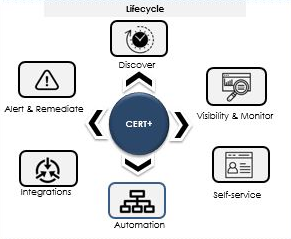
What is Certificate Lifecycle Management (CLM)?
There is a growing need for organizations to allow and control only specific individuals, devices, machines to gain access to the network. The need for digital certificates to authenticate, identify and control who can access and operate on an organization’s network. Managing digital certificates across complex networks to ensure protection and prevent failures is a must for all businesses. CLM ensures continuous monitoring of digital certificates, with the ability to audit and keep track of expirations and renewals to avoid any service disruption. The digital certificate is a mechanism by which machines and individuals are identified and authenticated.
What is x.509 Digital Certificate?
The digital certificate is a mechanism by which machines and individuals are identified and authenticated. Digital certificates (x.509 certificates) are essential to establish trust and authenticate the identity of machines, people, and so on.
It helps to verify the identity between users in operation, servers, and other entities in a network. Also, identifies servers from whom the encrypted data is received, the signer of information, and helps to establish authenticity and integrity. The x.509 digital certificate protects information belonging to enterprises and their customers.
- Name of the certificate holder.
- Serial Number that is used to uniquely identify the service, individual, or entity identified by the certificate.
- Expiry date.
- Copy of the certificate holder's public key (used for decrypting messages and digital signatures).
- Digital Signature of the certificate-issuing authority.
Composite Certificates
CLM supports Composite certificates as a first-class certificate type in the
inventory. Composite certificates combine a Post-Quantum Cryptography (PQC)
algorithm with a traditional (classical) algorithm into a single certificate for
example, MLDSA44-RSA2048-PSS-SHA256.
Composite certificates can be added to the CLM inventory through:
- Certificate issuance via Enroll Certificate (CLM) or Issue Certificate (PKI)
- Certificate upload
- Certificate discovery
Composite certificates are available across all CLM inventories: Server, Client, Code Signing, Root, and Intermediate CA.
Representation for Composite Certificates
Composite certificate attributes are displayed differently from classical certificates in the inventory. The following table describes how each attribute is shown:
| Attribute | How It Is Displayed for Composite Certificates | Example |
|---|---|---|
| Key Algorithm | Full composite algorithm string | MLDSA44-RSA2048-PSS-SHA256 |
| Hash Algorithm | Only the classical algorithm's hash portion | SHA256 (from
MLDSA44-RSA2048-PSS-SHA256) |
| Public Key Length | Full algorithm name (instead of a numeric bit length) | MLDSA44-RSA2048-PSS-SHA256 |
Certificate Authority
A Certificate Authority (CA) is also known as a certification authority or certificate issuer and is an establishment that validates the identities of certificate requesters and associates them to a cryptographic key through the issuance of electronic documents known as digital certificates.
Core Capabilities of CLM
- Integrate with multiple Certificate Authorities (CAs) for certificate provisioning.
- Integrate with and manage services across native cloud services like Amazon Web Services, Microsoft Azure, and Google Cloud Platform.
- Discover, monitor, analyze, orchestrate and fully automate certificate lifecycle management and key management solutions.
- Manage certificates as a service with pre-built integrations and extensible APIs that plugin to your enterprise applications, web servers, micro services, and multi-cloud environments.
- Analyze certificates for crypto standards like key size, cipher strength, and allowed protocol versions.
- Setup policies for enforcing high crypto standards.
- Update certificates as per new policies.
- Provision certificates for devices and applications.
- Monitor certificate status in real-time.
- Setup alerts on certificates to prevent security breaches.
- Support for Composite (PQC + Classical) certificates: Composite certificates are treated as first-class inventory items with tailored cryptographic attribute representation. Compliance checks are skipped for composite certificates to prevent false non-compliance results.
