
Automating CLM for CheckPoint
Prerequisites
- General prerequisites:
- Ensure communication between AppViewX and the firewall is enabled.
- AppViewX needs an internet or proxy connection to communicate with the firewall via the REST API.
- Valid firewall account details, including API tokens/keys and user credentials, are necessary.
- The API must have elevated (admin) permissions to read and modify SSL certificates.
- The username and password entered during the device onboarding process must be identical in both the Gaia Portal and the Smart Console user accounts. This ensures consistency, as the same credentials will be used for authentication in Gaia CLI and Management REST API sessions.
- Admin Portal: To read/modify the certificate used for admin portal, cat/echo commands are needed. Generic linux commands can be executed only in expert mode. In order to switch to expert mode admin privileges has to be given in the Gaia portal for a user.
- HTTPS Inspection: To read/modify inspection rules and to add server
certificates, these are the permissions needed in Checkpoint Management Smart
Console.
- Access Control > General > Access Control Objects and Settings > Write.
- Others > Permissions > HTTPS Inspection > Write.
- Management > Publish sessions without an approval > Write.
- Management > Management API Login > Write.
- IP Address/FQDN: IP address or FQDN
- User Privilege:
- Username/Password
- Credential List AppViewX/CyberArk
- If authentication relies on an external credential such as AppViewX, Thycotic, BeyondTrust, Hashicorp, and CyberArk, ensure that the hostname, FQDN, or IP address used for device communication is configured in the corresponding external credential vault.
- Platform: Security Management Server
- Enable Password: Required
- License Check: Not required
- Services
- Admin Portal (requires SSH port)
- HTTPS Inspection (requires https port).
- Supported versions: vR75.x, vR77.x, vR80.x, vR81.x
- Internet Access/Proxy: Not required
- Location from which the certificates are discovered if Certificate Managed:
- Certificates are fetched by issuing a direct command to the device through SSH.
- Location in the device:
- /web/conf/server.crt
- /web/conf/server.key
Note: Discovering the certificates used for inbound inspection is not feasible because Checkpoint does not provide an API to retrieve the content of the certificates. Therefore, only the formation of profiles for the server certificates' shared location and the inspection policies will be done by AppViewX.Note: For Visual Workflow action items, you will require credentials with write privilege.
Onboarding CheckPoint Device
-
Go to Menu > FIREWALL+ > DEVICE MANAGEMENT >
Inventory> Firewall.
By default, the Firewall tab opens.
-
In the Firewall tab, click
 (Add) icon located upper right corner.
The Add page appears.
(Add) icon located upper right corner.
The Add page appears. - Select the CheckPoint vendor from the left command bar.
-
Enter the field information in the General Information section.
Table 1. Field and Description Table Field Description CI name Name of the CI. Platform Select the platform from the drop-down list. The available options are: - Security Management Server
- MultiDomain Security
*Device name Unique custom identifier of your device. Onboarding Group Select the onboarding group to assign the device. Note: Devices without an assigned group are automatically mapped to the Default group during migration, onboarding, and when edited without existing group mappings.Communication The communication mode that firewall devices can be added to AppViewX. The possible communication modes are: - IP Address - The IP Address can be IPV4 and it can be either management IP or Self IP of the Firewall device. By default, the IP address has been selected.
- FQDN - On adding the device with FQDN, it will be resolved to an IP address and communication to the device will be made through it. If the FQDN is resolved to more than one device IP, AppViewX will choose a random IP for communication.
*IP address/FQDN Enter the IP address or FQDN based on the selected communication mode. Data center The data center on which the device has been hosted. Select from an existing list or enter a new data center. Cert sync Provision to discover and manage the SSL certificates from the firewall devices. The possible Cert syncs are: - Managed - All SSL certificates will be discovered and added to AppViewX certificate inventory and used for certificate lifecycle management like renew, revoke, etc.
- Monitored - All SSL certificates will be discovered and will not have any CA-related communication.
- Ignored - No SSL certificates will be discovered from the firewall device.
Note: The certification sync is based on the license applied.*Services Select the required services. By default Admin Portal is selected. The available services are, - Admin Portal
- HTTPS Inspection.
Note:- If you select HTTPS Inspection, the HTTPS Port field becomes enabled, and inspection profiles appear in the application connector.
- HTTPS supports only profile discovery, certificate push, and certificate binding.
*SSH Port Enter the SSH port number on the field. *HTTPS Port Enter the SSH port number on the field. *: Mandatory fields -
Enter the field information in the Credentials section:
Table 2. Field and Description Table Field Description *Credential type Credentials can be manually provided or stored as a one-time entry onto the credential library and referred at the time of device addition. Select one of the following credential types from the dropdown list: - Manual Entry - The user name and password of the device need to be entered with device details. By default, the Manual Entry option is selected.
- AppViewX Credential List - The user name and password can be
added to the List and that entry can be referred to during device
addition. The credential lists are integrated within AppViewX application
for the secured authentication.
To create a credential list, see Creating Credential List in the Platform User Guide.
*Username Username for the firewall device when you select the Manual Entry credential type. *Password Valid password for the firewall device when you select the Manual Entry credential type. Note: Use strong passwords for secure device communication. Your Passwords can be of any length with a combination of alpha-numerical, symbols, and special characters.*Expert password Enter the privilege password. *: Mandatory fields -
Enter the field information in the Secondary device information section as
follows:
- Auto-Detect - This option will automatically detect the corresponding secondary devices and add it as a new entry into AppViewX inventory using the Primary device’s credential.
- Manual Entry - This selection will enable you to manually add Secondary devices with a Sync-group name entered for reference. This name will be used to identify the pairs in the inventory. Follow similar steps.
- Ignore - This option can be enabled if you need to ignore the detection of the secondary device associated with the current device.
Note:- By clicking the Add button, multiple devices can be added as secondary devices and all the devices will be available in the grid.
- By managing the Primary and Secondary devices in AppViewX during the device flips, traffic routing and management can be seamlessly handled in AppViewX.
-
Click the Save button to add an Firewall device.
Note:
- To discard the changes, click the Cancel button.
A pop-up message is displayed as Device added successfully.
Validating the CheckPoint Device Addition
-
Go to Menu > FIREWALL+ > DEVICE MANAGEMENT >
Inventory> Firewall.
By default, the Firewall tab opens.
-
Search the device name and validate whether the device is added
successfully.
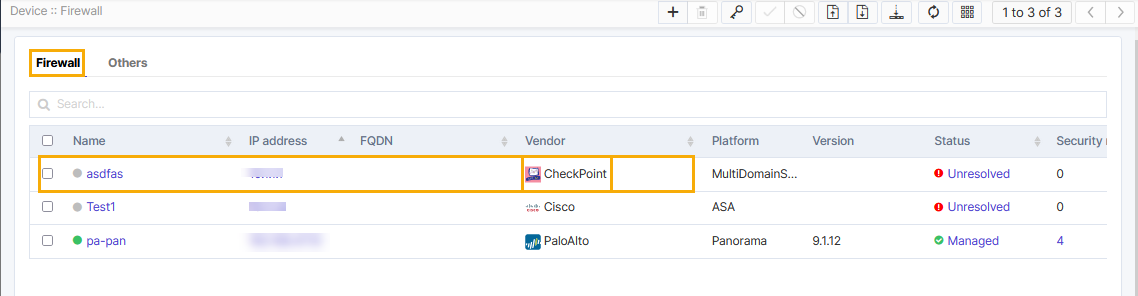
Onboarding Certificates for CheckPoint
- Via certificate discovery, for existing certificates
- Via certificate enrollment, for new certificates.
Discovering Certificates for CheckPoint
-
Go to
 (Menu) > CERT+ >
CERTIFICATE DISCOVERY > Discovery > Managed Devices
Scan.
The Discovery : Managed Devices Scan : Add Discovery page is displayed.
(Menu) > CERT+ >
CERTIFICATE DISCOVERY > Discovery > Managed Devices
Scan.
The Discovery : Managed Devices Scan : Add Discovery page is displayed. -
To initiate a managed devices scan, enter the Discover Details.
-
Enter the details for initiating an on-demand managed
devices certificate discovery scan.
Table 4. Field descriptions for on-demand discovery Field Description Discovery Instance Name Enter a name for the discovery instance. Description Enter additional details related to the discovery option. Note: Character limit: 2000 charactersOR
Enter the details for initiating a scheduled managed devices certificate discovery scan.
Table 5. Field descriptions for scheduled discovery Field Description Discovery Instance Name Enter a name for the discovery instance. Description Enter additional details related to the discovery option. Note: Character limit: 2000 charactersOccurrence Type From the dropdown list, from the following options, select an occurrence frequency:- Daily
- Weekly
- Monthly
- Yearly
*Repeat On Note: This field is displayed only when Occurrence Type = Weekly.Select the checkbox corresponding to the day of the week on which you want the discovery occurrence to repeat.*Starts On Click  (Calendar widget)
to select a date to start the scheduled
discovery.
(Calendar widget)
to select a date to start the scheduled
discovery.*Ends From the following options, select when the scheduled discovery is to end: - Never: Discovery never stops.
- After: Discovery stops after the number of occurrences specified in the text field.
- On: Discovery stops on the date
selected using
(Calendar widget).
Summary Displays a summary of the selections made for scheduled discovery *: Mandatory fields
-
Enter the details for initiating an on-demand managed
devices certificate discovery scan.
-
In the Discover By section, enter the discovery details.
Table 6. Instruction for discovering certificates Field Description *Discovery From From the dropdown list, select Managed Firewalls. Devices window A list of all the managed firewall devices is displayed in the devices window. To select devices for certificate discovery, select the checkbox(es) for the required devices.
The devices window has the following option:
- Add as Favorites: You can mark your frequently used devices as favorites.
- All: Select this to see the complete list of devices (unfiltered).
- Selected: Select this to list only the selected devices.
- Unselected: Select this to list only the unselected devices.
- Delete: Delete the required devices from the favorites list.
Execute Batches Sequentially To execute the discovery operation on the specified batches sequentially, select this checkbox. *Interval Between Batches If Execute Batches Sequentially is selected, enter an interval duration (in minutes) in this field. The sequential execution of the batches is spaced according to the interval value entered here. *: Mandatory fields -
In the Discovery Rules section, from the Associate Rule
dropdown list, select a rule that will be used to filter the discovered
certificates.
A set of filters is combined to create a rule, from the Rules menu. The selection of rules will apply respective filters on discovered certificates.
-
In the After Discover section, enter the following
details:
Table 7. Field descriptions for the After Discover section Field Description *Move Certificate to Inventory with Status Select from one of the following options: - Do not move: The newly discovered certificates and their objects will not be moved to the inventory.
- Managed: The newly discovered certificates and their objects will be moved to the inventory with the status set to Managed.
- Monitored: The newly discovered certificates and their objects will be moved to the inventory with the status set to Monitored.
Use Access Control Rule To apply the rule configured using Access Control, select this checkbox. Note: If this checkbox is enabled, the certificate group will be associated automatically by the rule in access control.*Certificate Group From the dropdown list, select a certificate group to which the discovered certificates will be associated. Based on the group association, a policy will also be applied to these certificates, which will help ascertain compliance or non-compliance.
*: Mandatory fields -
Click Discover/Schedule to trigger the
on-demand/scheduled discovery, respectively.
The discovered certificates are displayed in the certificate inventory.
Enrolling Certificates
Enrolling a Server Certificate
Prerequisites
Enrolling a Server Certificate
To enroll a server certificate:
-
Go to (Menu) > CERT+ > CERTIFICATE
ACTION > Enroll Certificate >
Server
The Enroll Server Certificate page is displayed.
- In the General Information section, from the dropdown list, select the required Assign Group.
-
Enter the CA Details.
Table 8. Field descriptions for the CA Details section Field Description *Certificate Authority From the dropdown list, select the certificate authority to request the certificate enrollment. Note: The IDnomic CA can be used for issuing certificates only in an on-prem deployment. Certificates issued through IDnomic CA can be renewed only if they are enrolled using a Registration Authority workflow.*Renew Automatically Note:To automatically renew this certificate:- If the Override feature is enabled for the certificate group selected from the Assign Group dropdown list, auto renew settings done in the enrollment page will be overwritten by the group level settings.
- If Regenerate Automatically has been enabled for the selected certificate group, the Renew Automatically field is not displayed here.
- Turn on the Renew
Automatically toggle.
The *Start Renewing field is displayed.
- In the Days Before Expiry field, specify
how many days prior to a certificate's expiry the
renewal process should start.
Valid range for number of days: 1 to 120
Note: The auto renew settings from the parent certificate will be transferred to the child certificate only if the toggle was enabled; they will not transfer if the certificate was renewed manually. After migration, these settings will be disabled for the parent certificate, so enable them manually if needed.*Regenerate Automatically To automatically regenerate this certificate: - Turn on the Regenerate Automatically
toggle.
The *Start Regenerating field is displayed.
- In the Days Before Expiry field, specify
how many days prior to a certificate's expiry the
regeneration process should start.
Valid range for number of days: 1 to 120
Note: This value can exceed the certificate's validity in case of short-lived certificates.
Note:- This feature can be enabled only for valid certificates (not for revoked/suspended and expired certificates).
- The auto regenerate settings from the parent certificate will be transferred to the child certificate only if the toggle was enabled; they will not transfer if the certificate was regenerated manually. After migration, these settings will be disabled for the parent certificate, so enable them manually if needed.
*Re-enroll Automatically To automatically regenerate this certificate: - Turn on the Re-enroll Automatically
toggle.
The *Start Re-enrollng field is displayed.
- In the Days Before Expiry field, specify
how many days prior to a certificate's expiry the
regeneration process should start.
Valid range for number of days: 1 to 120
Note: This value can exceed the certificate's validity in case of short-lived certificates.
Note: User overrides are allowed unless Group Override is active, in which case the group's configuration takes precendence.*CA Account From the dropdown list, select the CA account to which the certificate enrollment request will be submitted. Certificate Type From the dropdown list, select the required certificate type. *Division Note: This field is applicable only for Digicert CA.From the dropdown list, select the division with which the certificate will be enrolled.Certificate Profile Note: This field is displayed for only selected CAs. For the IDnomic CA, this field is displayed when only-CA setting is selected from the CA Account dropdown list.From the dropdown list, select the certificate profile with which the certificate must enroll.
*RA Workflow Note: This field is displayed when Certificate Authority = IDnomic and a RA setting is selected from the CA Accounts dropdown list.From the dropdown list, select the RA workflow that will be used for certificate enrollment.For the details of a workflow, you can check them on your CA portal on IDnomic.
*Issuer Location Note: This field is applicable only for Google CA.From the dropdown list, select the issuer location associated with the CA account.
*Issuer Name Note: This field is applicable only for Google CA and AppViewX PKIaaS Native.From the dropdown list, select the issuer name for issuing the certificate.
Template Name Note: This field will be displayed only when Certificate Authority = AppViewX Native CA.Select a template name from the dropdown list.
Template Name is editable. The selected template will be displayed in the Template/Profile column of the Server Certificate Inventory irrespective of the Managed/Monitor status. You can also search and filter certificates based on the template name within the CERT+ Inventory.
*Issuance Policy Note: This field is applicable only for Futurex.From the dropdown list, select the issuing policy for this certificate.An issuance policy defines the rules Futurex must follow to process the certificate enrollment request. The selected issuance policy will determine the approval requirements for the certificate, the cryptographic settings, notification triggeres and other configuration parameters.
*Root CA Note: This field is applicable only for Futurex.From the dropdown list, select the root CA for the certificate being enrolled.This is the trusted root certificate authority that anchors the certificate chain. All issued certificates will ultimately chain up to this root.
*Signing CA Note: This field is applicable only for Futurex.From the dropdown list, select the Certificate Authority that will sign the requested certificate.*Extension Profiles Note: This field is applicable only for Futurex.Extension profiles enable you to further modify your certificates with additional field, attributes, and requirements.From the dropdown list, select the extension profile that will be used for the certificate being enrolled.
To read more on and for instructions to create extension profiles, refer the Futurex documentation. For links, see the References section.
*Approval Group Name Note: This field is applicable only for Futurex.An approval group is a predefined set of users or roles authorized to approve the certificate enrollment request.From the dropdown list, select the approval group to authorize this enrollment request.
To read more on and for instructions to create and manage approval groups, refer the Futurex documentation. For links, see the References section.
*Connector Name Enter a friendly name for the CA connector. On saving this form, the name entered here will be displayed in the holistic view.
Description Note: Character limit: 2000 charactersEnter the description in this field.
*CSR Generation Note: This field is applicable for all CAs except Amazon.From the following options, select the required method for generating the CSR:
- AppViewX: Private key and
CSR will be created in AppViewX based on CSR
parameters given.Note: If auto regeneration has been enabled for this cerificate, AppViewX can be enforced as the default CSR generation source (irrespective of any selections made here) every time the certificate is regenerated. To do this, execute the following db script:
db.cert_metadata.insertOne({"_id":"CERT_AUTO_REGENERATE_DEFAULT_APPVIEWX_CSR", "flag":true}) - Upload CSR: You can
upload a file that contains the CSR details. This
source file will be used to populate the CSR
parameters, which will then be submitted to the
CA.
- Under CSR Generation, select Upload
CSR.
The Please paste your CSR field is displayed.
- From the Please paste your CSR field, select Browse.
- Navigate to the location of your CSR file, and click Open.
- Click Upload.
On successful upload of this file, the CSR fields are populated with the corresponding details.
- Under CSR Generation, select Upload
CSR.
- HSM: Note: This option is disabled/not displayed when Certificate Authority = Google, CSC Global, and DigiCert One.To generate the private key and the CSR, based on the CSR parameters given in an HSM device:
- Under CSR Generation, select HSM.
- To enter the configuration details for CSR generation, refer the field descriptions given here.
- End
Point: Note: This option is disabled when Certificate Authority = Google and CSC Global.To generate the private key and the CSR, based on the CSR parameters given in an endpoint device:
- Under CSR Generation, select End Point.
- To enter the configuration details for CSR generation, refer the field descriptions given here.
*: Mandatory fields Table 9. Field descriptions for using HSM as the CSR generation source Field Description *Device Type From the dropdown list, from the following options, select the type of device on which the private key and the CSR will be generated: - HSM Devices (AppViewX will directly communicate with the HSM device for the CSR generation.)
- ADC Devices (The selected ADC device will interact with the HSM to generate the CSR and subsequently transmit the relevant details to AppViewX.)
*Vendors This field is displayed only when Device Type = ADC Devices. From the dropdown list, select the required ADC device vendor.
Module Number This field is displayed when Device Type = ADC Devices and Vendors = Thales. In the event that multiple HSMs are configured on a system, module number is a unique identifier assigned to each HSM.
In this field, enter the module number assigned to the selected Thales device.*Devices From the dropdown list, select the required HSM/ADC device. This field is populated based on the Device Type and Vendors selected.
- For Device Type = HSM
Devices
The dropdown list is populated with HSM devices that were enabled for CSR generation at the time of onboarding and have been successfully onboarded. To read more on onboarding HSM devices in AppViewX, click here.
- For Device Type = ADC
Devices
The dropdown list is populated with F5 devices that are in the Managed state.
Currently, AppViewX enables HSM key generation only through F5 devices for the following HSM vendors and their respective supported versions:- Fortanix (v14 and onwards)
- Thales (v12 and onwards)
- Safenet (v12 and onwards)
*Key Handler Name This field is displayed when Device Type = HSM Devices. Key handler name refers to an identifier used to reference a cryptographic key managed by an HSM device.
Enter the desired handler name in the field.*Key Reference Name This field is displayed when Device Type = ADC Devices. Key reference name refers to an identifier used to reference a private key that is stored locally on an ADC device or is securely accessible to the device via an external HSM.
In this field, enter the reference name assigned to the private key stored in/accessible to the selected ADC device.Table 10. Field descriptions for using an endpoint device as the CSR generation source Field Description Category From the following options, select the ADC device category: - ADC
- Cloud
- Server
- WAF
- Firewall
Note:- Run the following script to enable endpoint
CSR generation support for
GlobalSignAtlas:
db.getCollection('cert_metadata').insertOne({ "_id": "CSR_GENERATION_ENDPOINT_SUPPORTED_VENDOR_GLOBALSIGNATLAS", "objectMap": { "Server": [ "ABAP", "Web Dispatcher" ] } }); - On selecting GlobalSignAtlas CA, Category is automatically populated as Server.
Vendor The dropdown list for this field is populated based on the Category selected. From the dropdown list, select the vendor for the end point device. Note:- On selecting GlobalSignAtlas CA, Vendor is populated with ABAP and Web Dispatcher.
*Devices This field lists the end point devices present in your environment that belong to the above selected Category and Vendor. From the dropdown list, select the end point device on which you want to generate the private key and the CSR.Note: On selecting Vendor = Fortinet, both Fortigate and FortiManager devices are populated. Auto-regeneration of certificates with FortiManager as endpoint is not supported.*Profile This field is applicable only when Category = Server/WAF. Select a profile from the dropdown list. Note: On selection of Vendor = Imperva, CSR generation at the endpoint is supported only for SaaS platforms. Profiles will not be displayed for AWS/on-prem deployments.*Tenant This field is applicable only when Category = AD. Enter the tenant ID. *Service name From the dropdown list, select the cloud service running on the selected cloud Devices. CSR Location This field is applicable only when Category = Server. *Template Name This field is applicable only when Category = Firewall. Select the required template from the dropdown list.
Note:- This field will be enabled when the Platform = Panorama while onboading PaloAlto device at Menu > CERT+ > Device Management > Inventory> Firewall > Add.
- Templates and partitions are used to enroll certificates at the template level. To enroll a certificate at the Panorama level, set the template to None.
Partition This field is applicable only when Category = Firewall. *CSR File Name Enter the name of the file that contains the CSR parameters. Note:- As the extension is already included in the field, ensure that you enter the file name without the file extension.
- Starting v2023.1.0 FP2, for enrolling Apache server certificates, this field is labeled as CSR File Location.
*Key File Name Enter the name of the file that contains the private key details. Note:- As the extension is already included in the field, ensure that you enter the file name without the file extension.
- Starting v2023.1.0 FP2, for enrolling Apache server certificates, this field is labeled as Key File Location.
*Certificate File Name This field is displayed only when Category = Cloud. Enter the certificate file name. *Key vault This field is displayed only when Category = Cloud, Vendor = Azure, and Service name = Key Vault (Azure). *Service Note: This field is displayed when Category = Server and Vendor = Microsoft Server.This dropdown list is populated based on the Device selected.From the options in the dropdown list, select the service.
*Exchange Server Note: This field is displayed when Category = Server and Vendor = Microsoft Server.From the dropdown list, select the name of the MS Exchange server for which the certificate is being enrolled. -
For the EJBCA certificate authority, enter the vendor details.
Table 11. Field descriptions for the EJBCA Vendor Specific Details section Field Description * End Entity Profile Name From the dropdown list, select the end entity profile name. End entity user name Enter the name of the end user entity. * Issuer Common Name From the dropdown list, select the issuer common name. *Certificate Profile Name From the dropdown list, select the certificate profile name. *: Mandatory fields Note: When generating a new private key on an endpoint, existing keys (including .txt encrypted key files) are not overwritten immediately.- For non–password-protected certificate types (PEM-.crt, PEM-.cer, PEM-.pem, DER-.der, DER-.cer, PKCS7-.p7b, PKCS7-.p7c), the .txt file is decrypted into the original key filename (keyfile.key) during the push. If a key with the same name already exists, it will be replaced.
- For password-protected certificate types (Default
JKS-.jks, JKS-.keystore, PKCS12-.p12, PKCS12-.pfx):
- During the push , the encrypted .txt file is decrypted into a temporary, timestamped key file (keyfile_.key).
- This decrypted key is then combined with the certificate
to create the final bundled output (e.g.,
.pfx,.jks). - After bundling, the temporary timestamped key file is deleted; Because the decrypted key file is temporary and timestamped, no key replacement occurs, and no existing key files are overwritten.
This is currently applicable for:- Linux vendors - Generic Linux, Apache Linux, Tomcat Linux, and Nginx Linux.
- Windows vendors - Windows Apache, Windows Tomcat, and Microsoft SQL.
-
For the certificate being enrolled, enter the CSR Parameters.
Note: For DigiCert One, all CSR parameters that are assigned static values in the certificate profile will be auto-populated and disabled for editing.
Table 12. Field descriptions for the CSR Parameters Field Description Replace PSE File The Replace PSE File checkbox enables users to generate the CSR or private key in the Server. This checkbox is displayed only in the case described below: - Select the CSR Generation radio button as Endpoint.
- Select Category as Server, Vendor as ABAP or Web Dispatcher The Profiles dropdown is the only other field displayed below it and is populated with a list of .pse file names.
- Select the required Profile from the dropdown. Based on the values selected, the fields in the CSR Parameters section are auto-populated.
The Replace PSE File checkbox is disabled by default and the SAN details fields in CSR Parameters section are also disabled. Selecting the checkbox will make the SAN details enabled and allow for values to be updated.
*Common Name Enter the certificate's common name. The common name is one of the key values of Certificate Signing Request (CSR) to be present in the certificate. For example, <appviewx>.
Note: Constraints:- Character limit: 64 characters
- No special characters allowed except en dash (_) and hyphen (-).
- For VMware vCenter, enter the device's FQDN to avoid certificates being rejected. If left blank, the FQDN will be auto-detected and populated.
Subject Alternative Name From the dropdown list, select the Subject Alternative Name category for the certificate being enrolled. In the corresponding field(s) displayed for the selection made, enter the required values.
Note:- Multiple values must be separated by a comma.
- After enrollment, the cumulative count of SANs is displayed in the certificate property pop-up window from the holistic view.
- For VMWare vCenter, enter the device's FQDN to avoid certificates being rejected. If left blank, the FQDN will be auto-detected and populated.
DNS Mutiple SAN values must be separated by a comma (,). Organization The organization name is one of the CSR parameters to be present in the certificate. This field will be auto-filled and editable based on the configuration in the selected group’s policy. Note: For VMWare vCenter, this is a mandatory field.Organization Unit Organization Unit name is one of the CSR parameters to be present in the certificate. This field will be auto-filled and editable based on the configuration in the selected group’s policy. Note: For VMWare vCenter, this is a mandatory field.Locality The locality name is one of the CSR parameters to be present in the certificate. This field will be auto-filled and editable based on the configuration in the selected group’s policy. Note: For VMWare vCenter, this is a mandatory field.State The state name is one of the CSR parameters to be present in the certificate. This field will be auto-filled and editable based on the configuration in the selected group’s policy. Note: For VMWare vCenter, this is a mandatory field.Country Country name is one of the CSR parameters to be present in the certificate. This field will be auto-filled and editable based on configuration. It must be a 2-letter country code (for example, US, and so on). Note:- For renewal of the certificate being enrolled, country name is required.
- For VMWare vCenter, this is a mandatory field.
Email Address Enter a valid email address of the person responsible for maintaining the certificate. Note: For VMWare vCenter, this is a mandatory field.*Validity To specify the validity of the certificate being enrolled: - From the first dropdown list, select the number of days/months/years.
- From the second dropdown list, select the unit
of the duration from the following values:
Days/Months/Year.For example, if the validity of the certificate is 2 months:
- From the first dropdown list, select 2.
- From the second dropdown list, select Months.
Note: The uploaded certificate validity for Globalsign MSSL is set to 365 days.Challenge Password Challenge password is one of the CSR parameters to be present in the certificate. Password must contain at least one alphabet (uppercase and lowercase), one number, and one special character. Confirm Password Re-enter the password entered in the Challenge Password field. *Hash Function The Hash function with which the CSR has to be signed. Any information specific to any CA or vendor has to be covered in the Note section. This field will be auto-filled and editable based on the configuration in the selected group’s policy. Note: For Certificate Authority = HydrantID, irrespective of the hash function selected, by default, the CA returns a certificate with SHA256. Therefore, admins must restrict users from creating a certificate with a hash function other than SHA256. To accomplish this, create policy with a single hash value (SHA256).*Key Type The key type is used while creating a private and public key pair. This field will be auto-filled and editable based on the configuration in the selected group’s policy. Note:- FortiManager supports only RSA key type of 512, 1024, 1536, 2048, 3072, 4096 bits.
- VMWare supports only RSA of 2048, 3072, 4096, 7680, 8192 bits and EC key type.
*Bit Length The bit length is used while creating a private and public key pair. This field will be auto-filled and editable based on the configuration in the selected group’s policy. *: Mandatory fields -
In the Attachments section, upload any additional documents that are
relevant to the enrollment of the certificate (for example, approval
emails).
Table 13. Field descriptions for the Attachments section Field Description Name Enter a name for the document. This need not be the actual name of the document; it can be an alternate name that will be used for reference only. Comments Enter any details relevant to the document being attached. Note: Character limit: 2000 charactersUpload File To upload an attachment: - Click Upload.
- Navigate to the location of the document to be uploaded.
- Select the document to be document and click
Open.
The selected document is uploaded and listed in the table displayed below these fields in the Attachments section.
Tip: If you have uploaded multiple attachments, use the Search field to find the required one.
*: Mandatory fields -
In the Certificate Attributes section, enter organization-specific
values, for the certificate attributes and custom attributes for the issuing
CA, that need to be mentioned along with the CSR.
These values will not be a part of the certificate but will be available in the AppViewX inventory. For example, cost center.Note: This additional information can be used to filter certificate details in the inventory.
-
Enter the relevant details in the Generic Fields. These are default
fields for maintaining the IP address and device information, if
required.
Table 14. Field descriptions for the Generic Fields Field Description Device Name Enter the name of the device. Application IP Address Enter the IP address of the application. Tracking ID A free-form business alpha-numerical identifier, included in the audit logs, that may be used to correlate audit log entries (typically enrollment and revocation events) Certificate holder Email Note: For the IDnomic CA, this field is displayed only when the selected CA account has been configured using a Registration Authority (RA).An email address that may be used to send notifications to certificate holder depending on the notification policies configured for the requested workflowFirst name Note: For the IDnomic CA, this field is displayed only when the selected CA account has been configured using a Registration Authority (RA).First name (as a metadata) associated with the certificate to be enrolledLast name Note: For the IDnomic CA, this field is displayed only when the selected CA account has been configured using a Registration Authority (RA).Last name (as a metadata) associated with the certificate to be enrolledOrganization Note: For the IDnomic CA, this field is displayed only when the selected CA account has been configured using a Registration Authority (RA).Organization name (as a metadata) associated with the certificate to be enrolledComment Note: For the IDnomic CA, this field is displayed only when the selected CA account has been configured using a Registration Authority (RA).Additional information (as a metadata) associated with the certificate to be enrolledUUID Note: For the IDnomic CA, this field is displayed only when the selected CA account has been configured using a Registration Authority (RA).Universal Unique Identifier, or UUID, (as a metadata) associated with the certificate to be enrolled -
In the Vendor-Specific Details section, enter the
CA-specific details. Some of the CAs will expect additional details other
than CSR parameters as meta data for their operational purposes. Details
common to all CAs will be taken from the AppViewX user information of the
logged in user.
Table 15. Field descriptions for the common vendor specific details Field Description Certificate ID The Certificate ID is auto-populated based on the value entered in the Common Name field (in the CSR Parameters section). - The Certificate ID can be modified by the user.
- If the user edits the Certificate ID, any change to the Common Name will not reflect in the Certificate ID.
- If the user deletes the Certificate ID, the value of the Certificate ID field is set to the Common Name suffixed with the timestamp.
Table 16. Field descriptions for the CSC Global CA vendor specific details Field Description *Server Type From the dropdown list, select the server on which the application that requires the requested certificate is hosted. *Business Unit Enter the name of the business unit that is requesting the certificate. *Organization Contact Enter the email address of the contact in the organization requesting the certificate. *Phone Number Enter the phone number of the Organization Contact in the followung format: +<country code>-<phone number>. Note: For CSC Global, the phone number is not fetched from the AppViewX user information because of the difference in format.*Domain Control Validation Type From the following options in the dropdown list, select the method CSC Global will use for authentication before issuing a certificate: - EMAIL: CSC Global will send an approval/confirmation request to the registered email ID. Certificate issuance happens only after approval is received.
- CNAME: On requesting certificate issuance, CSC Global will provide you with a dynamic string. Add a CNAME record with this string to your DNS settings. CSC will issue the certificate requested only after validating this CNAME record.
Note: CSC Global will perform domain validation for all CLM actions.*: Mandatory fields Table 17. Field descriptions for the Custom CA vendor specific details Field Description *CRL and OCSP required To control the inclusion of CRL and OCSP settings, turn this toggle button on/off as required. *: Mandatory fields Table 18. Field descriptions for the DigiCert CA vendor specific details Field Description *Server Type From the dropdown list, select the server on which the application that requires the requested certificate is hosted. *Payment Method From the dropdown list, select one from the following payment methods: - Bill To Account Balance:
This option allows you to pay for the DigiCert
certificate using the available balance in your
DigiCert account.Note: Ensure that the option to bill to account balance is enabled for the account and the account has sufficient balance.
- Bill To Default Credit
Card: This option will charge the cost
of the DigiCert certificate to the credit card set
as the default payment method in your DigiCert
account.Note: Ensure that a credit card is configured as the default payment method for your account.
Additional Email Enter email addresses that will receive notifications for renewals, reissues, and duplicates for the specified order. Renewal Message Enter a custom message that will be sent with the renewal notifications. Notes Enter a custom note that will be sent with the order. *: Mandatory fields Table 19. Field descriptions for the DigiCert One CA vendor specific details Field Description Seat ID Enter the seat ID that will be assigned to the certificate being enrolled. Seat ID is a unique user-defined value assigned to identify an entity in the DigiCert One account. The seat ID for a certificate is used for certificate enrollment, renewal, and regeneration.Note: The Seat ID field is displayed only if the Allow Seat ID during enrollment option is selected for the CA account. In this case, the value entered in the Seat ID field is now a unique identifier for the certificate being enrolled. Otherwise, a common seat ID is assigned to all certificates enrolled for the selected CA accountTable 20. Field descriptions for the GlobalSign MSSL CA vendor specific details Field Description *Profile name A profile name is defined at the time of creating an account on the GlobalSign MSSL portal. AppViewX retrieves all your profile names from the GlobalSign MSSL portal and populates them in this dropdown list. From the dropdown list, select the profile name the enrolled certificate should be mapped to.
*: Mandatory fields Table 21. Field descriptions for the Hydrant ID CA vendor specific details Field Description Expiry Emails Enter a comma-separated list of email addresses that will receive the certificate expiry notification from HydrantID. Note: HydrantID CA does not accept updates to these email addresses during the renewal process.Table 22. Field descriptions for the Nexus CA vendor specific details Field Description Procedures The Procedures dropdown list will display only the procedures mapped to the server and the default procedure. From the dropdown list, select the required procedure. Table 23. Field descriptions for the LetsEncrypt CA vendor specific details Field Description *Challenge Type Specifies the method for verifying domain ownership. Select the required domain for the validation. The available challenge types are: - HTTP
- DNS.
Challenge Verify Determines how the DNS challenge will be verified. Select the required verification process. The available challenge verifies are: - Manual
- Automatic.
Note: This field appears when the challenge type is selected as DNS.Vendor Indicates the DNS provider responsible for managing DNS records. The available DNS service providers are: - Cloudflare
- Azure.
Note: This field appears when the challenge verify is selected as Automatic.*Settings Allows for additional configuration settings related to the DNS challenge. The selected value None implies that no extra settings are applied. Note: This field appears when the challenge verify is selected as Automatic.Note:- Make sure that you have enabled LetsEncrypt DNS Automation from the workflow.
- To add new vendors for the integration and configuration, refer to Integration topic in the Automation Guide.
*: Mandatory fields -
Click Add.
Once the details are added, you will be redirected to a page where the CSR and CA details are added as a connector. This page is called the holistic view and from here, any action on the certificate can be performed including provisioning the certificate to a server.
-
On the holistic view, click the Submit button to
trigger the request.
The submit action is triggered and the Submit dialog box is displayed.
-
Enter your comments in the text field and click Yes.
If the approval required option is enabled in the CA policy, the request is moved to the Approve and Implementation stages.
-
Click Approve to proceed.
The Approve dialog box is displayed.
-
Enter your comments in the text field.
Note: If the workflow request has to be approved automatically in the future, click the Schedule later button .
-
Click Yes.
Once the approval process is complete, the Implement option is displayed in the holistic view.
-
Click Implement.
The Implement dialog box is displayed.
-
Enter your comments in the text field.
If the workflow request has to be implemented automatically in the future, click Schedule later .
-
Click Yes.
CSR Submission to CA is in progress.Once the CSR submission is successful, the request state will be changed to Submit certificate - retrieval in progress state.
If the enrollment request is compliant with conditions defined and auto-approval enabled in the targeted CA, the certificate will be fetched in a few seconds.
If auto-approval disabled in the targeted CA, you will have to be logged into the CA and approve the request.
Once the certificate is issued successfully, the certificate will be retrieved into AppViewX. You can now push the enrolled certificate(s) to the required endpoint.
Pushing Certificates to a CheckPoint Device
Adding an Application Connector for CheckPoint
-
Enter the General Information for the connector.
Field Description *Category From the dropdown list, select Firewall. *Vendor From the dropdown list, select CheckPoint. *Connector Name Enter a name for this connector, to be able to identify it later. AppViewX recommends naming connectors according to use cases so they are easily distinguishable.
Description Enter any additional details you want to record for this connector. Based on the information populated here, the Profile Selection section is populated with the list of available devices for the specified vendor that are already onboarded in AppViewX.Note:Profiles will be discovered irrespective of the cert sync option selected during device addition or during an on-demand discovery.- Admin Portal: The Admin portal CLM integration in
AppViewX with CheckPoint is primarily designed to
discover and manage the server certificate found at the
file path '/web/conf/server.crt' in both SMS and
MDS environments.Note: For executing linux commands, it's necessary to enter expert mode on the CheckPoint device. This is achieved using the command 'expert'. During the device addition process in AppViewX, an expert password field is provided to facilitate switching to expert mode when required.
- HTTPS Inspection: HTTPS Inpsection has to be
enabled in services during device on-boarding to perform
end-to-end automation for inspection certificates.
- Push Only Profile
Format: deviceName:HTTPSInspection:ServerCertificate
Description: This profile is used for pushing server certificates only. It does not bind the certificates to any specific inspection rules. - Push and Bind Profile
Format: deviceName:HTTPSInspection:InspectionLayerName:RuleNumber:RuleName
Description: This profile is used for both pushing and binding certificates. It binds the certificates to specific inspection rules defined by the rule number and rule name.
- Push Only Profile
- Admin Portal: The Admin portal CLM integration in
AppViewX with CheckPoint is primarily designed to
discover and manage the server certificate found at the
file path '/web/conf/server.crt' in both SMS and
MDS environments.
-
To select the device(s) to which the certificate will be pushed, under
Profile Selection, from the list of Available Devices,
click
 .
The Selected devices list is updated automatically.
.
The Selected devices list is updated automatically. -
Enter/Select the Certificate Details.
Table 24. Field descriptions for the Certificate Details Field Description *Certificate Type From the dropdown list, select the file type of the certificate to be pushed. *Certificate File Name Enter the file name of the certificate to be pushed. The file extension is auto-populated based on the Certificate Type selected. Password Enter the password required to access the certificate file/trust store. Push Root and Intermediate Certificates To push the root and intermediate certificates, along with the end certificate, select this checkbox. -
Enter/Select the Push Details.
Table 25. Field descriptions for the Push Details Field Description *Script Location Script files are commonly used to perform certain tasks required to be completed before and/or after a certificate is pushed to the target system. The script to be run before the certificate is pushed is called a pre-push script and the script to be run after the push is called a post-push script.
From the following options, select the location of the script file(s):
- In AppViewX
- In Device
Pre - Push Script File Name Enter the file name of the pre-push script. Important: Read the pre and push script usage instructions here.Pre - Push Script File Path This field is displayed when Script Location = In Device. Enter the location on your local system where th pre-push script file is stored.Important: Read the pre and push script usage instructions here.Post - Push Script File Name Enter the file name of the post push script. Important: Read the pre and push script usage instructions here.Post - Push Script File Path This field is displayed when Script Location = In Device. Enter the location on your local system where the post-push script file is stored.Important: Read the pre and push script usage instructions here.Overwrite The Overwrite option is used to specify if existing certificates on the target system will be overwritten with the certificate being pushed. If this option is enabled, the certificate being pushed will overwrite any existing certificates with the same identifier on the target system. This will also ensure that only the latest version of the certificate is available on the target system.
If it is disabled, the push operation will fail in the event of conflicts with the certificates on the target system.
Push Automatically To automatically push the certificate after it is renewed/reissued to the target system, enable this checkbox. Note: The auto push feature for a certificate works only if enabled for the certificate application connector as well the associated certificate group. To enable this feature at the certificate group level, refer the instructions here. -
Click Save.
The connector is displayed on the certificate holistic view.
Pushing a Server Certificate
-
Go to (Menu) > CERT+ > CERTIFICATE ACTION >
Push to Device > Server.
The Server Certificate page is displayed.
-
To push a certificate, under Common Name, click the required certificate.
The certificate topology view is displayed.
-
Click Push to Device. The Push to Device option will be shown if
the app connector is already added to the certificate otherwise add the app connector and
then proceed.
Note:
- Only server certificates that include their private keys will be eligible for push
operations to cloud connectors.
After push, during subsequent discovery, when the CC machine is healthy and discovery returns the pushed certificate, the pushed AppConnector should be in Sync status, else the associated AppConnector must be transitioned to an Out of Sync status.
If a new certificate is pushed to the gateway while the old certificate for the AppConnector still exists in the inventory, then after the next discovery, the AppConnector must move to Out of Sync status for the old certificate.
- Endpoint CSR generation is not supported for cloud connectors.
- The Push to Device option is displayed only after an app connector is added to certificate.
The Confirmation dialog box is displayed. - Only server certificates that include their private keys will be eligible for push
operations to cloud connectors.
- Enter your comments, if required, in the text field.
-
Click OK.
- The approval process is triggered. The current flow is based on the default policy of two-level approvals.
- A request ID and work order ID are generated automatically and the work order status is displayed alongside the connector in the certificate topology view.
- To approve the push request, from the certificate topology view, click Approve.
-
In the Confirmation dialog box:
- In the Manual Implementation field, to choose the mode of implementation, use the On/Off toggle.
- If you select Off, set the date and time to schedule the certificate push.
- Enter your comments in the text field and click Yes.
The work order status displayed beside the connector updates to Push-Review In Progress. - To implement the push request, from the certificate topology view, click Implement.
-
In the Confirmation dialog box:
- In the Manual Implementation field, to choose the mode of implementation, use the On/Off toggle.
- If you select Off, set the date and time to schedule the certificate push.
- Enter your comments in the text field and click Yes.
The push action is triggered. After the push action is completed, the status updates to Completed.To refresh the certificate topology view, from the top-right corner of the screen, click Refresh.An automatic HTTPS-based verification job is run at regular intervals to validate that certificates are correctly installed after the push operations triggered between the intervals; the system compares served certificates with the expected ones across all associated IP:ports. The data gathered by this job is used to create the Push Validation Report that highlights the proportion of successful versus failed push operations, providing a quick view of overall push reliability.
Enabling Auto Regeneration of Certificates
Enabling Auto Regeneration for a Certificate Group
You can enable and configure the auto regeneration feature at the certificate group level, which will apply to all certificates assigned to that group.
For details and instructions to enable auto regeneration at the certificate group level, click here.
Enabling Auto Regeneration at the Certificate Level
Enabling Auto Regenerate for Certificate Enrollment
For details and instructions to enable auto regeneration at the time of server certificate enrollment, click here.
Enabling Auto Regenerate for Discovered Certificates
-
Go to Menu > CERT+ >
Certificate Inventory >
Server.
The Server Certificate inventory is displayed.
-
From the inventory, for the certificate you want to enable auto push
for, click the common name.
The holistic view of the selected certificate is displayed.
-
For an existing CA connector for the certificate, hover over
 .
.
-
From the menu displayed, click Edit.
The certificate details are displayed.
- Under CA Details, turn on the Regenerate Automatically toggle.
- In the Start Regenerating field, enter the number of days before expiration when the certificate should be regenerated.
-
Click Update.
The holistic view of the selected certificate is displayed.Note: For the auto regenerate process to take effect, set the auto push in the application connector. Refer to the Enabling Auto Push section.
Enabling Auto Push of Certificates to Endpoints
To enable auto push of certificates, you need to enable the corresponding option for the group to which the certificate in question belongs, as well as the connector created for that certificate.
-
To enable auto push for the certificate group:
-
To enable auto push for the certificate connector:
-
From the holistic view, for an existing application connector for the
certificate, hover over
 (More) icon.
To add an application connector, follow the instructions given here.
(More) icon.
To add an application connector, follow the instructions given here.
-
From the holistic view, for an existing application connector for the
certificate, hover over
Enabling Auto Renewal of Certificates
-
To enable auto renewal for the certificate group:
-
To enable auto renewal for the certificate connector:
-
For an existing CA connector for the certificate, hover over .
-
For an existing CA connector for the certificate, hover over
Troubleshooting Check point Firewall
Issues when device goes to unresolved state after on-boarding
- Attempt to establish an SSH connection from the AppViewX installed node or CC node to the Check point server.
- Verify if there is proper connectivity between the nodes and the Check point server.
Issues when device goes to failed state with version failure
- Login to the Check point SMS server via CLI using the credentials configured in AppViewX.
-
Attempt to enter expert mode. The user should be able to switch to expert
mode.
- Verify the expert password provided during on-boarding is correct.
- Confirm expert mode privileges are granted for the user account.
-
Once in expert mode, execute the following command:
fwm
                            ver
. This command should confirm the server is indeed a Check point SMS server and display the version details of the server.Sample expected output:This is Check Point Security Management Server R81.20 - Build 440
