
Configuring a CA Policy for Digicert CA
-
Go to
 (Menu) > CERT+ >
GROUPS & POLICIES > CA
Policy.
The CA Policy page is displayed.
(Menu) > CERT+ >
GROUPS & POLICIES > CA
Policy.
The CA Policy page is displayed. -
Click + Create from the top-right corner of the page.
The CA Policy :: Create page is displayed.
-
Refer the Configuring Policy Details section to configure the
following:
- Policy Details
- Group Selection
- Compliance Check
-
In the CA Details section, from the
Certificate Authority list in the left, select
DigiCert.
The CA Details section is updated to display fields relevant to DigiCert.
-
Enter the policy details for DigiCert.
Table 1. Field description for CA details Fields Description *CA Account From the dropdown list, select an existing CA account for which this policy is to be created. *Division Select the division from the dropdown list. *Certificate Type Certificate types corresponding to the selected CA account are listed. Select one (or) more certificate types from the list to create the policy. *Validity Enter a validity period for the certificate. The available options are: Days - You can enter more than one validity period in days, to choose one in certificate enrolment.
Month - You can enter more than one validity period in Months, to choose one in certificate enrolment. Year - You can enter more than one validity period in Year, to choose one in certificate enrolment.
Year - You can enter more than one validity period in Year, to choose one in certificate enrolment.
*: Mandatory fields -
In the Vendor Specific Details section, select/enter the
details as listed in the table
Table 2. Field description for Vendor Specific Details Fields Description *Server Type Select the server type from the dropdown list. *: Mandatory fields -
Click Add.
The CA details are added to the table below the Add button and a confirmation message is displayed.Note: You can use the Edit option in the table to modify the configuration and the Remove option to delete the configuration.
- Select the Bit Length -Key Type, ECDSA curve, and the Hash Function.
-
Based on your organization's policies and standards, enter values for the
Certificate Parameters.
Table 3. Field description for certificate parameters Fields Description Restrict Wild Card Certificate Slide toggle switch to the ON position to restrict the creation of wild card certificates using the policy. Host name Enter the host name. The host name cannot start and end with a . (period)
*Allowed Domain Names Enter only the whitelisted domain names. Press enter after adding the domain name. Multiple domain names can be added.
Common Name Enter the common name. For example, *.domain.com This enforces domains for which a certificate can be requested. The common name is enforced at the time of performing any certificate request operations such as New, Renew, and Regenerate.
Note: Use the * (asterisk) for the host part of the FQDN to enforce the domain. For example, *.domain.com will only allow users to request certificates with domain.com. Allowed special characters: *(Asterisk), - (hyphen), . (period).Organization Enter the organization name. The discovered certificate's subject organization will be compared against the organization provided in the policy to check for compliance. The organization is enforced at the time of performing any certificate request operations such as New, Renew, and Regenerate.
Organization Unit Enter the organization unit. The discovered certificate's Subject Organization Unit will be compared against the organization unit provided in the policy to check for compliance. Organization Unit is enforced at the time of performing any certificate request operations such as New, Renew, and Regenerate. Locality Enter the locality name. The discovered certificate's locality will be compared against locality provided in the policy to check for compliance. The locality is enforced at the time of performing any certificate request operations such as New, Renew, and Regenerate.
State Enter the state. The discovered certificate's state will be compared against the state provided in the policy to check for compliance. The state is enforced at the time of performing any certificate request operations such as New, Renew, and Regenerate.
Country code Enter the country code. The discovered certificate's country code will be compared against the country code provided in the policy to check for compliance. Country code is enforced at the time of performing any certificate request operations such as New, Renew, and Regenerate.
Email Enter the email address of the organization unit. The discovered certificate's email address will be compared against the email address provided in the policy to check for compliance. The email address is enforced at the time of performing any certificate request operations such as New, Renew, and Regenerate.
Subject Alternative Name Enter the subject alternative name (SAN). It helps enforce additional domains for which a certificate can be requested. The SAN is enforced at the time of performing any certificate request operations such as New, Renew, and Regenerate. Note: Use the * (asterisk) for the host part of the FQDN to enforce the domain. For example, *.domain.com will only allow users to request certificates with domain.com. Allowed special characters: *(Asterisk), - (hyphen), . (period)*: Mandatory fields -
Click Save CA Details to save the configuration.
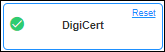
A green tick mark is displayed in the Certificate Authority pane against Digicert to indicate that the details are successfully stored.
- From the Group selection section, select one or more groups to map to the policy.
-
From the Compliance Check section, to perform an
immediate compliance check, enable Perform Compliance
check.
Note: A scheduled compliance check will run periodically based on the settings defined in the job scheduler.
-
Click Create Policy to create a new policy.
The policy is created and a confirmation message displays.
